
Richard Arlin Walker
Special to ICT
It was shortly after 1 a.m. February 9 and musher Pete Kaiser, Yup’ik, and his dog team were on their way to a record-tying ninth win in the Kuskokwim 300, the highly regarded mid-distance sled dog race between Bethel and Akiak, Alaska.
Winning this race would be significant for any musher and team but was uniquely meaningful to Kaiser.
Bethel, where the race starts and finishes, is Kaiser’s hometown. The Alaska Native population here is 62 percent. Alaska Natives comprise 94 percent of the population in Akiak, 68 percent in Aniak, 94 percent in Tuluksak, and 85 percent in Upper Kalskag, other checkpoints in the race.
Kaiser and his dogs traveled a landscape that his forebears knew long before European and American contact. The Kuskokwim Mountains and the tundra beyond the banks of the Tuluksak River. Upper Kalskag, only accessible in winter by ice roads. And Aniak, where the eponymous river flows into the Kuskokwim River.
The Northern Lights danced across clear, starry skies as Team Kaiser claimed the title. Kaiser and his dog team maintained an average moving speed of 10.2 mph over the course of the 300-mile race – one-tenth of a mile faster than second-place finisher Riley Dyche – to finish with an 18-minute lead.
“There are some deep, deep ties to people’s roots and traditions out here with having sled dogs and racing sled dogs,” Kaiser told ICT the next day. “For a long time, that’s how Alaska Natives got around. If you had a good dog team, you had a good life. Dogs are not used in that manner as much anymore, but it’s cool that they can be raised and trained and still have some significance in the culture up here.”
The Kuskokwim 300, aka the K300, has long been a race where teams can show what they’ve got before competing in the Iditarod a month later. The 975-mile Iditarod was founded in 1973 to celebrate the Alaska sled dog, on which Alaska Native peoples relied for centuries. But the number of Alaska Native mushers in the Iditarod has dwindled to one.
Not so the K300, which consistently draws some of the most prominent Native and non-Native competitive mushers. A musher can make a name here and earn a decent check in a third of the time and distance of the Iditarod.
“You don’t just win this race by chance. Most people in the sport are aware of this race,” Kaiser said. “The best teams in the world have been coming out here since it started in the early ’80s. It started with Rick Swenson and Susan Butcher and Joe Redington. And every year since then, you have some of the best dog drivers in the world coming out here to race. So, yeah, I think it’s the most competitive, it’s the most prestigious. It’s got the biggest purse, it’s got the best community involvement. It’s the best organized race and it’s been that way for a long time and it continues to be that way.”
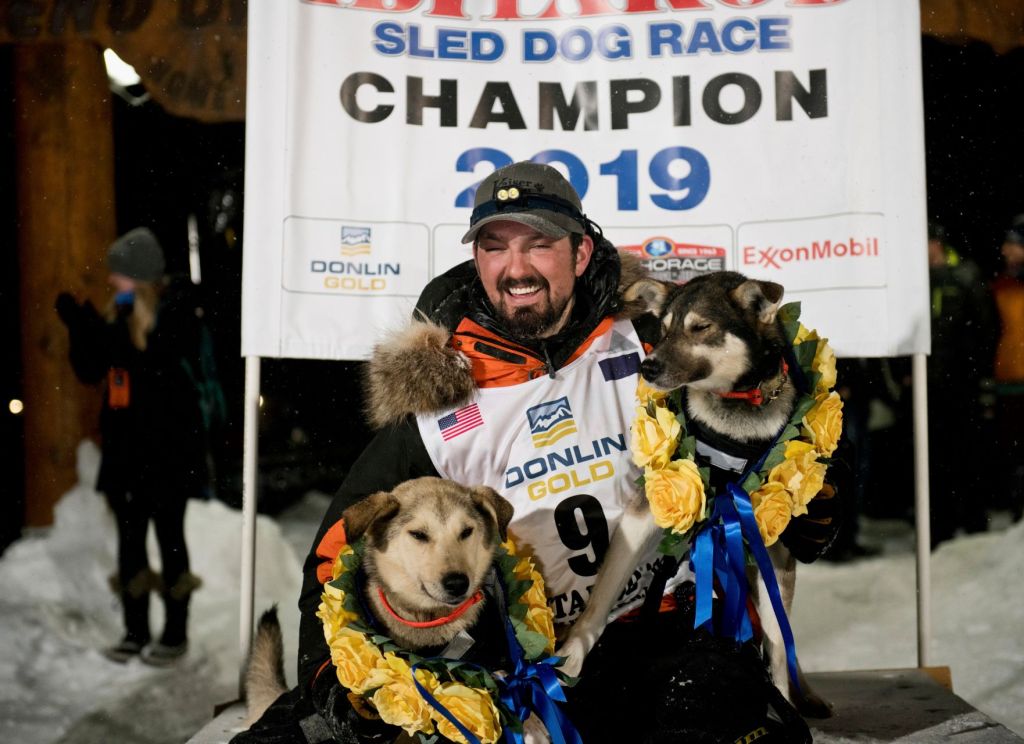
About the economics: Kaiser and his team finished the K300 in 1 day 12 hours 41 minutes and received a check for $31,700. By comparison, he and his team placed ninth in the 2024 Iditarod, finishing in 9 days 18 hours 30 minutes 50 seconds and taking home $25,800. (He won the Iditarod in 2019 and received $51,299.)
“The payout is definitely more money per mile,” Kaiser said of the K300. “It would be nice to have another race or two like the K300 around the state. I think that would really help boost the mushing economy a little bit. But this race is one of a kind as far as the amount of money they pay out.”
‘We’re going to continue in the mid-distance races’
While Alaska Native presence in the Iditarod has declined, Native presence remains strong in the mid-distance races.
Inupiaq mushers Ryan Redington, Robert Redington and Isaac Redington competed in the Knik 200-mile sled dog race January 4-7. Ryan Redington, who won the Iditarod in 2023 and the John Beargrease Sled Dog Marathon in Minnesota in 2018 and 2020, placed second in this year’s Knik 200 and is the lone Alaska Native competitor in this year’s Iditarod.
A field of seasoned competitors vied for the Kuskokwim 300 title, among them past Iditarod champions Redington and Kaiser; past Iditarod top-five finisher Mike Williams Jr., Yup’ik; and past February 50 Doubles Race champion Isaac Underwood, Athabascan.
An all-Indigenous field competed February 8 in the Akiak Dash, an annual 65-mile race between Akiak and Bethel. Raymond Alexie, Yupiaq, scored a trifecta – his second Akiak Dash win, preceded by first-place finishes in the 50-mile Holiday Classic on January 16 in Bethel, and the 35-mile Season Opener on January 1, also in Bethel. His total winnings: $9,600, about what he’d earn placing 20th in the Iditarod. Total distance raced: 150 miles, compared to the Iditarod’s nearly 1,000.
Williams Jr. won the Bogus Creek 150 – a 150-mile race between Bethel and Bogus Creek – on February 23 with a time of 16 hours 8 minutes. He received a check for $15,000 – almost as much as he earned for a 13th-place finish in the 2011 Iditarod (his career best in the Iditarod is eighth, in 2012). The Bogus Creek 150 featured an all Alaska Native field of mushers.
Farther north, only Inuit mushers are eligible to participate in March in the Ivakkak 310, an annual 310-mile race in Nunavik. Look for a strong Indigenous presence as well in the Kobuk 440, an annual 440-mile race that begins April 3 in Kotzebue; and the Nunavut Quest, an annual 230-mile race in April from Igloolik to Arctic Bay in Nunavut.
Alaska Native mushers say Indigenous participation in their sport is culturally important. Sled dogs are as much a part of Alaska Native culture as canoes are to the First Peoples of the coasts and horses are to the First Peoples of the Plains. Without mushing, an important part of Alaska Native culture would be gone – the traditional mode of travel on ancestral trails, the relationship between musher and dog.
Mike Williams Sr., a veteran competitive musher and father of the Bogus Creek 150 champ, said he hopes the Alaska Native presence in the Iditarod will rebound. He’s raced in the Iditarod to call attention to sobriety and twice received the Most Inspirational Musher award.
“We’re going to continue in the mid-distance races, you know, but the Iditarod needs to continue,” he said. “Entries have fallen pretty bad. I did 29 Kuskos and 15 Iditarods. If I could afford more Iditarods I’d run the Iditarod every year. It’s a money issue for our local mushers here not to enter the Iditarod because of the expenses for food and logistics and extra things to get to the race line. And I know – I’ve done 15 of them and it was a struggle.”
A changing climate, too, is problematic for rural mushers who don’t live on the road network. They must travel farther away from their homes, families and jobs to find ideal conditions in which to train. Iditarod competitors were forced to make late changes to their schedules and strategies after that race’s committee decided on February 17 to change the start location because of lack of snow. The K300, too, was postponed for two weeks because of poor trail conditions resulting from limited snow and numerous warm spells.
Kaiser, a veteran of 15 Iditarods with one championship and nine top-10 finishes, is sitting the Iditarod out for the first time.
“We had a really tough time training here,” Kaiser said. “I considered signing up late for the Iditarod, but with no snow and ice it kind of burnt me out a little bit. So I think I’m going to enjoy having a little time to watch it from the sidelines and kind of reset.”
Getting back to the ‘old Iditarod’
The Iditarod Trail Sled Dog Race was founded by Joe Redington Sr. and Dorothy Page in 1973 to keep alive the heritage of the Alaska sled dog, which was being supplanted in rural villages by snowmobiles.
The Iditarod bills itself as the Last Great Race and few would disagree. Part of the race incorporates trails used in the 1925 Serum Run, a sled dog relay to rush life-saving medication to remote communities plagued by diphtheria. Mushers and dogs cross hills and mountain passes, tundra and forests, rivers and sea ice, and the frigid Bering Sea coast en route to the finish line in Nome.
Alaska Native mushers and their dogs dominated the earliest Iditarods. Athabascan mushers Carl Huntington, Emmitt “The Yukon Fox” Peters and Jerry Riley won the 1974, 1975 and 1976 races, respectively. Other top Alaska Native mushers in those days included George Attla, Rudy Demoski Sr., Warner Vent, and Herbie “The Shishmaref Cannonball” Nayokpuk.
Other mushers, non-Native and Native, contributed to the storied event. Rick Swenson, a non-Native musher from Two Rivers, was the first musher to win the race five times. Libby Riddles of Nelchina, Alaska, was the first woman to win the race, in 1985; Susan Butcher of Knik, Alaska, followed with titles in 1986, 1987, 1988 and 1990.
The late Lance Mackey won the Iditarod and the 1,000-mile Yukon Quest in four consecutive years – 2007, 2008, 2009 and 2010. John Baker became the first Inupiaq to win the Iditarod in 2011. Then, the Age of Seavey began, with Mitch or his son Dallas winning the next six Iditarods.
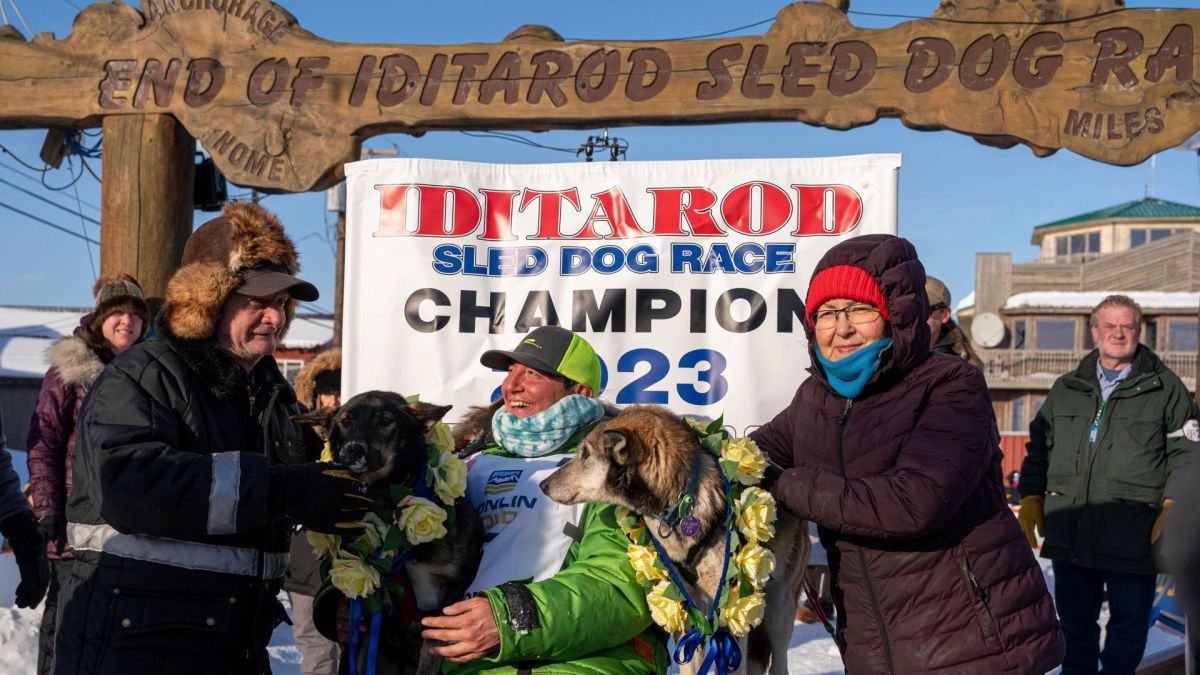
Ryan Redington, Pete Kaiser and Richie Diehl finished first, second and third in 2023, the first Alaska Native top-3 finishers since Huntington-Vent-Nayokpuk in 1974.
And with each Iditarod, the race became faster, something that concerns Jeff King, four-time Iditarod champion and nine-time K300 winner. Dick Wilmarth won the first Iditarod, in 1973, in 20 days. Peters, the Yukon Fox, won in 1975 in 14 days. Dog breeding, nutrition, training and gear evolved and the top finish times dipped to 10 days in 1992, 9 days in 1995, and 8 days in 2010. Dallas Seavey set a record of 7 days 14 hours 8 minutes 57 seconds in 2021.
Consider this: the last finisher in 2021 – Victoria Hardwick of Bethel – crossed the finish line in 10 days 9 hours 22 minutes 6 seconds, better than every champion from 1973 to 1991.
There’s been a cost to faster races. Some 118 dogs have died during the race since the event’s inaugural run in 1973, according to HumaneMushing.org; causes of death include gastric ulcer, hypothermia, pneumonia and accidents.
King (Iditarod personal best: 9 days 5 hours 43 minutes 0 seconds, in 1996) suggested to ICT in 2024 that mushers and dogs be required to take an additional six eight-hour rests (they are currently required to take two eights and a 24). With the additional required rest, the 2024 race would have been won in 11 days, rather than nine.
ICT unsuccessfully reached out to King several times recently for another interview. But he said in an earlier interview that slowing the race would enable mushers and teams to spend more time in Alaska Native communities where residents turn out to cheer mushers and teams. Now-retired musher Aliy Zirkle, whose 20-year Iditarod career included seven top 10s and three consecutive second-place finishes, was popular in these communities, always having time for an autograph or a photo with a fan.
Several awards given at checkpoints during or after the race are distinctly Alaska Native: musher’s mitts with beaver and beaded leather by Loretta Maillelle, Athabascan, of McGrath; a beaver hat made by Oline Petruska, Athabascan, of Nikolai; salmon filets from the Bristol Bay Native Corporation; a wood-burned art piece by Apay’uq Moore, Yup’ik; a hand-carved loon by Mark Delutak Tetpon, Inupiaq; and art by the Nayokpuk family.
“We would stop and rest, we would be in the villages along the way more, we would be taking even better care of our dogs,” King said of slowing the race. “The villages would have mushers in them longer. The villages used to really embrace us because we would stay there. Now we’ve got mushers zooming through.”
Mike Williams Sr., the veteran musher and sobriety advocate, sides with King.
“I agree that the only way to slow down the race is to have mandatory village rest stops,” Williams said. “When you get to the village, you can’t camp out elsewhere. I’ve seen it before, when families in each community hosted. I think if we’re going to get back to the old Iditarod, we’ve got to take a look at all the rules.”
Two past champions in 2025 Iditarod
This year’s Iditarod – the 100th anniversary of the Serum Run – begins at 10 a.m. March 1 with a ceremonial start in downtown Anchorage, followed by the official restart March 3 at 11 a.m. local time in Fairbanks.
The field of 33 mushers includes 17 veterans and 16 rookies from four countries (Canada, Denmark, Norway, U.S.) and seven U.S. states (Alaska, Idaho, Michigan, Minnesota, Montana, New Hampshire, Wisconsin). Fans will recognize three mushers from reality TV: Lauro Eklund, “Mountain Men”; Jessie Holmes, “Life Below Zero”; and Quince Mountain, “Naked and Afraid.”
Two mushers are past Iditarod champions: Ryan Redington, 2023; and Mitch Seavey, 2017, 2013, 2004. Nine mushers have finished in the top 10; three are past second-place finishers.
Seavey is by far the most seasoned musher, having competed in 27 Iditarods with 18 top-10 finishes. Redington has completed 10 Iditarods and has four top-10 finishes.
Holmes, the “Life Below Zero” star who finished third, fifth and third in the last three Iditarods, told Iditarod Insider that he’s been working out and getting into the shape he was in when he ran ultramarathons. His weight has increased from 140 to 162, mostly muscle, he said. (Holmes and his dog team won the Copper Basin 300-mile race in January.)
“There’s a lot of hungry mushers out there,” Holmes said of the competition on Iditarod Insider. “Don’t underestimate them.”
Ryan Redington, the 2023 champion, said he’ll miss Kaiser and Diehl on the trail. “It was pretty epic to have my dream come true and win the race and to race it out with Pete and Richie there,” he told Iditarod Insider. “They are really amazing mushers. To have us three Alaska Native mushers be the top three finishers that year, it was a really amazing race.”
Redington’s regimen includes making sure his dogs eat well and get plenty of sleep during the race. He’ll make sure he stays hydrated, eats well and catches some sleep when he can. In that, he knows the value of each minute. He crossed the finish line one hour before Kaiser in 2023. “If I had slept any longer, I might not have won,” he said.
2025 race season
January 4: Knik 200 Joe Redington Sr. Memorial Sled Dog Race – annual 200-mile race starting in Knik (Ryan Redington finished second)
January 11: Copper Basin 300 – annual 300-mile race starting at Glennallen (Winner: Jessie Holmes)
February 2: Yukon Quest 450 – annual race from Teslin to Faro to Teslin. (Winner: Michelle Phillips)
February 7: Kuskokwim 300 – annual 300-mile race on the Kuskokwim River (Winner: Peter Kaiser)
February 8: Akiak Dash – annual 60-mile race from Bethel to Akiak and back. (Winner: Raymond Alexie)
February 22: Bogus Creek 150 – annual 150-mile race from Bethel to Bogus Creek and back. (Winner: Mike Williams Jr.)
March 2: Iditarod Trail Sled Dog Race – annual 1,000-mile race to Nome. (Winner: TBD)
March: Ivakkak – annual 310-mile race in Nunavik (Hudson Bay, Hudson Strait, Ungava Bay, Quebec). Only Inuit mushers are eligible to participate. (Winner: TBD)
April 3: Kobuk 440 – annual 440-mile race starting and ending in Kotzebue.(Winner: TBD)
April: Nunavut Quest – annual 230-mile race from Igloolik, Nunavut to Arctic Bay, Nunavut. (Winner: TBD)

Our stories are worth telling. Our stories are worth sharing. Our stories are worth your support. Contribute $5 or $10 today to help ICT carry out its critical mission. Sign up for ICT’s free newsletter.

