
Kalle Benallie
ICT
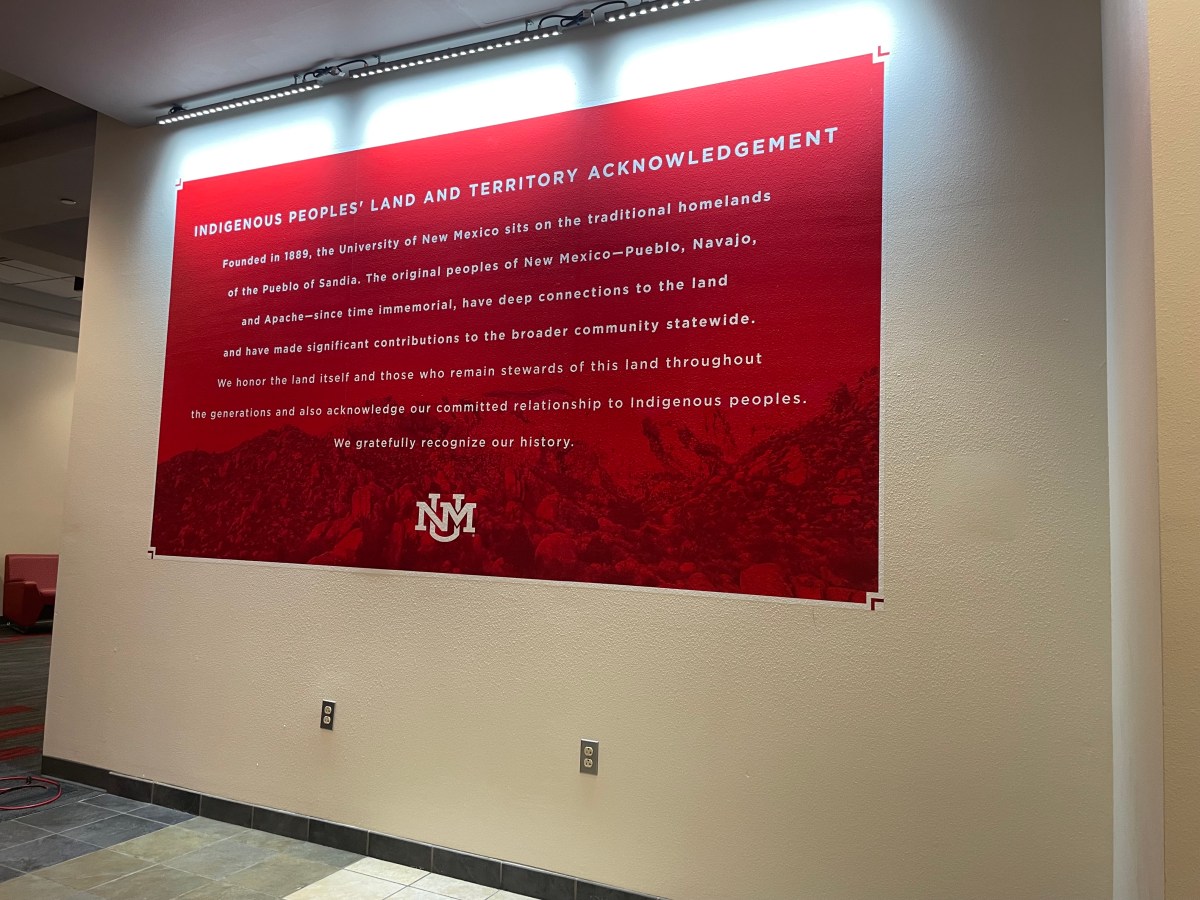
ALBUQUERQUE, N.M. — An Indigenous peoples’ land and territory acknowledgement was unveiled on May 5 and placed at the heart of the University of New Mexico campus.
The mural is on the main level of the Student Union Building that acknowledges the university and their branches campus being on the traditional homelands of the Pueblo of Sandia and the pueblo, Navajo and Apache people have deep connections to the land and have made significant contributions across the state.
“By respectfully honoring our history through an Indigenous land and territory acknowledgment, we are formally, and gratefully, recognizing Indigenous Peoples as a vital part of our Lobo DNA,” UNM president Garnett S. Stokes said. “Our land acknowledgment has become a foundational part of our identity as Lobos, and I am proud that today it is becoming—quite literally—a permanent part of our very infrastructure.”
Other universities have issued land acknowledgments across the country. One is Arizona State University, which also has a high Native student population and Native population in the state.
Stokes spoke on how the student diversity today does not look how it did when the school opened in 1892. There were zero Native students in the beginning and almost none for the next 35 years, according to Stokes.
Then from and since the tenure of President James Zimmerman from 1927 to 1944, thousands of Native students have attended and graduated the university.
Nearly 11 percent of New Mexico’s population is represented by 23 federally recognized Native nations, including 19 pueblos, three Apache nations and the Navajo Nation. It makes New Mexico the third largest Native population per capita in the United States.

Savannah Peat, a university communication representative at the University Communication and Marketing, said the large scale of the acknowledgement is “as big as it is important.”
“What’s the point of acknowledging such an important part of our university’s history and New Mexico’s history if it’s not going to be proudly on display. I think that was something that definitely went into it,” she said.
Stokes said discussions about it began in 2016 at the suggestion of Native faculty and resulted in one of the early drafts. Pam Agoyo, the director of American Indian student services who also serves as Stokes’ special assistant for American Indian affairs, made her aware of it.
It was first read at the fall 2018 commencement ceremony.
Then in 2020, the Native American Faculty Council did a final revision and the Indigenous peoples’ land and territory acknowledgement was adopted.
Student Union Director Cheryl Wallace said the idea to have the acknowledgement in the student union building came from her associate director Dennis Ray Armijo.
“We met a few months ago and through his research of other universities, he noticed they were posting the land acknowledgement in student union’s. He felt this would be a great idea and a wonderful opportunity to showcase our new land acknowledgement here in the SUB,” she said.
One visitor at the campus came across the mural and quickly took a picture of it.
“It’s not a small plaque at the side of the building. It’s sort of centered like I saw it and immediately recognized it and thought ‘hey that’s kind of cool,’ she said.

Our stories are worth telling. Our stories are worth sharing. Our stories are worth your support. Contribute $5 or $10 today to help ICT carry out its critical mission. Sign up for ICT’s free newsletter.
