Jolan Kruse
Special to ICT
Minnesota’s license plate program to fund missing and murdered Indigenous cold cases has brought in nearly half a million dollars one year after it kicked off.
Minnesota state Sen. Mary Kunesh, the first Indigenous woman in the state senate, said she stood on the state capitol grounds one day in 2023 admiring the designs on license plates of cars in the parking lot.
At the time, she was planning on creating a state-wide reward fund for missing and murdered Indigenous relatives, inspired by a similar effort in Duluth by State Rep. Liish Kozlowski.
The Standing Rock Sioux Tribe descendant said the license plates led to an epiphany.
Kunesh said she wanted to create a plan that could allow for a continual flow of money, rather than relying on funds from the federal government, which can be subject to budget cuts.
With the help of state representatives and Minnesota’s Missing and Murdered Indigenous Relative’s Office, the license plate program launched on Valentine’s Day of 2024, also a day of remembrance for missing and murdered Indigenous relatives.
The supporting reward fund program followed, launching on July 23, 2025. All proceeds go through the office to directly fund a tipline that assists in the closing of MMIR cold cases, Kunesh said.
In the year since the reward fund program began, more than 6,000 people registered for the license plates, generating roughly half a million dollars.
“This was wildly successful,” Kunesh said. “This is a movement that continues to grow nationally and worldwide that Minnesota is leading in just about every way of approaching and addressing this issue.”
Plates cost $15.50 for cars and $13.50 for motorcycles. A minimum contribution of $25 is required to apply for a plate and for each renewal of the plate.
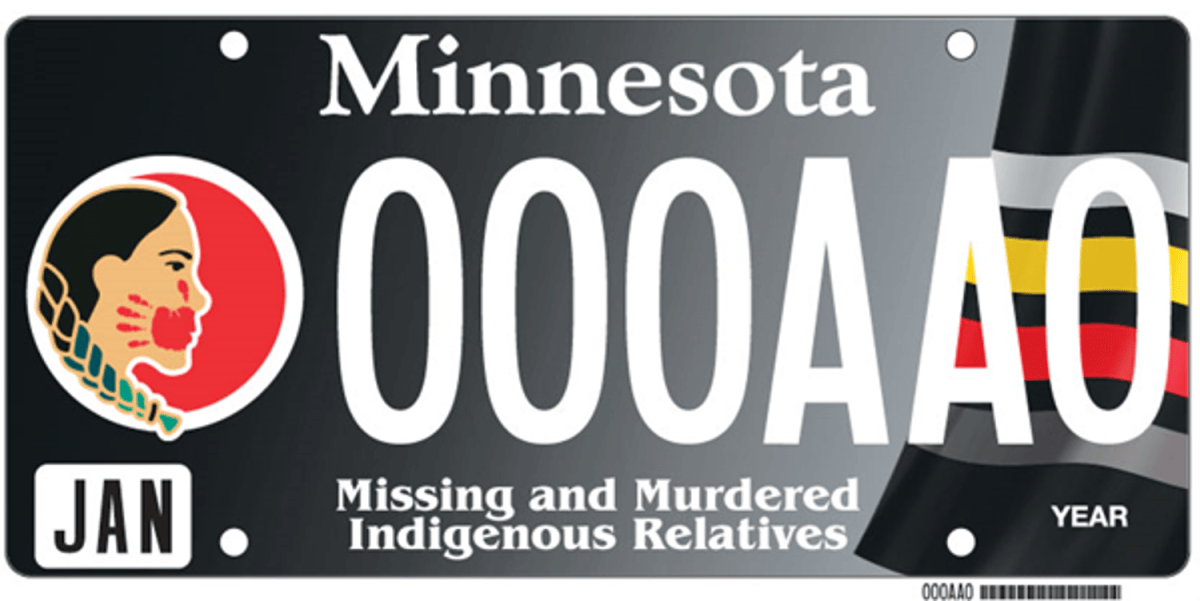
The licence plates display a black background paired with a ribbon skirt and a red handprint.
“The reason why red is really important is that some tribes believe red is the color that the spirit world can see and we need our relatives to know that we will never stop looking for them,” said Minnesota state Rep. Heather Keeler, the lead writer in state House for the reward fund program and a citizen of the Yankton Sioux Tribe.
According to the state’s office of justice programs, 732 Indigenous people were reported missing in Minnesota in 2025. Proceeds from the reward fund program allow for rewards ranging from $1,000 to $10,000 for tips on missing and murdered cases.
Tips do not have to result in prosecution for the reward to apply, said Kozlowski, the first Transgender and Two-Spirit legislator in the country and a citizen of the Fond du Lac Band of Ojibwe.
People reporting tips also work directly with the MMIR office instead of law enforcement, Kozlowski said, which makes some people more comfortable and willing to come forward.
Seventy percent of MMIR cases are declined due to a lack of evidence, Kozlowski said. “These tips are the evidence that allow these families to get accountability,” she added.
Both the license plate program and the reward fund program are overseen by the MMIR office, which launched in February 2022, becoming the first MMIR office in the nation.
The office includes resources for impacted families and law enforcement and information on violence prevention. The establishment of the office came from the state’s MMIR Task Force, created by Kunesh.
“The number one recommendation that came out of the task force was to create an office for missing and murdered Indigenous relatives and we have done that,” Kunesh said.
Sheila Lamb, who was a member of the MMIR task force, said she and her daughters are all proud MMIR license plate owners.
“I feel it was absolutely long overdue and vital to the area given the amount of reservations that we have,” Lamb said. “It only makes sense for Minnesota to do this and be in the forefront of it.”
The state is home to 11 federally recognized tribes with Lt. Gov. Peggy Flanagan, White Earth Nation, leading the state as the highest-ranking Native woman holding an executive office.
Lamb, who is White Earth Ojibwe and Eastern Cherokee, said since getting the license plate, it’s led to conversations with people who ask where they can get one and how they too can support the cause.
“It made me very proud that we did this but also very heartbreaking to know the need is there,” Lamb said.
Lamb, who is also a Cloquet City Council member and advocate for survivors of human trafficking said going forward she would like to see a continued uplifting of the MMIR office and more resources for funding searches, burials and travel for court.
Kozlowski said the office just passed funding to include a case review coordinator to make sure MMIR “isn’t just a hashtag, it’s a movement.”
“The progress is really coming from people coming together and refusing to look away, and I couldn’t be prouder of our community or more angry that this is what we have to continue,” Kozlowski said.
This story has been updated to specify that Sheila Lamb is White Earth Ojibwe and Mary Kunesh is a descendant of Standing Rock Sioux Tribe.