

Kalle Benallie
ICT
Peterson Zah, who died earlier this week, left behind a massive legacy in both the impact he had as both a tribal and educational leader, but as a fondly remembered icon who has inspired several generations.
Zah died Tuesday in a hospital in Fort Defiance, Arizona, after a lengthy illness. He was 85.
The burial service will be on Saturday on the Arizona side of the Navajo Nation with the procession starting in Window Rock and ending in Low Mountain. A nearly 100-mile journey west.
Zah’s storied legacy began when he led the Navajo Nation out of one of its darkest political eras, following a deadly riot incited by the tribe’s former chairman Peter MacDonald, a year earlier.
Zah was the last chairman of the Navajo Tribal Council and held that position as the tribe reorganized its government into a three-branch system to prevent any sole power, like the chairman’s office, from gaining too much power. In 1990, the people elected Zah as the first elected president of the Navajo Nation.
“When the people saw the riot of the public safety building in Window Rock and then saw the result of the federal government’s prosecution of Mr. MacDonald, it was inevitable that they would return to Pete’s leadership because there was that deep reservoir of trust,” said Eric Eberhard, a longtime friend and coworker of Zah.
“I think he maintained it after he left the presidency,” Eberhard said. “He never really stopped being involved in Navajo politics up until just a few days before he walked on earlier this week.”
Zah’s career saw him leading in tribal politics, both public and higher education and in tribal law. In each field, it is not hard to find people who have been deeply influenced by Zah’s kindness, intellect and traditional ties.
Mellor Willie, co-founder and director of 7Gen Leaders, a Native Political Action Committee, knows people will recount all of Peterson Zah’s legislative and leadership accomplishments while he was Navajo Nation president, but he remembers how Zah would frequently talk about his time serving on the Window Rock School District as a school board member being the foundation for it all.
“He always said ‘if you really want to look at politics, you become a school board member because that’s where you learn how to find political agreements and how you’re able to navigate the political world,’” the Navajo Nation citizen said.
Zah acted as a mentor for Willie and would tell him about looking at the bigger picture, on how issues would impact tribal sovereignty and the elders who are living on reservations.
“It’s just a huge loss for the Navajo Nation. We have very few leaders on Navajo that could really dissect national and local political issues like Pete did,” he said.
Willie knew Zah his entire life with his parents working on Zah’s reelection campaign for chairman in the summer of 1986. He helped raise money by making campaign buttons and selling them at fairs, rallies and parades across the Navajo Nation. Later, he worked with Zah as an intern at college and as advisors for Chee Consulting LLC.
Willie said Zah’s work was greatly benefited by his wife Rosalind. He remembers how she would drop him off at different places for meetings and Zah would ask Willie to give him a ride.
“The value of time that I appreciated was on the car rides going from a meeting back to his hotel and we share perspectives. He was always willing to share his different, many battles that he was going through,” he said.
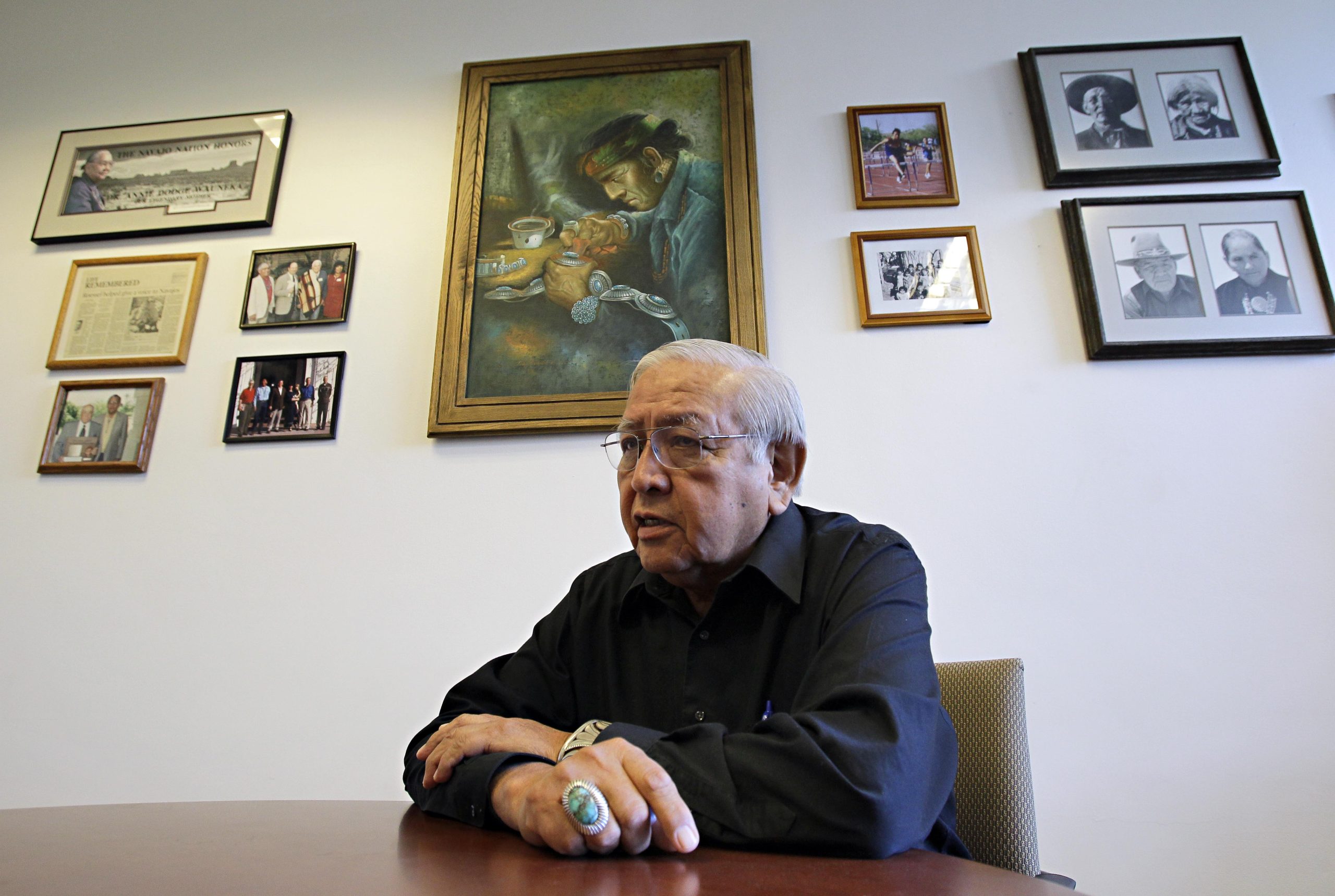
Willie was told by his brother, who worked at Utah State University, about Zah not only speaking with the students but also the university leadership on the importance of investing in Native students. He pushed colleges and universities to accept Navajo students — regardless of whether they graduated in the Arizona, New Mexico or Utah portion of the reservation — at in-state tuition rates.
“He loved the fact that Navajo students were going to college. He wanted them to be successful and bring back their knowledge to help the Navajo People,” he said.
Jaynie Parrish, Diné, was one of those students that Zah was advocating for and who would also look to Zah as a valued mentor.
She said he was very approachable, kind and honorable. She first met him when she saw his office was close to where her class was at Arizona State University. She would later shadow him for a research project and learn about his leadership style.
“That was an incredible learning experience as a student. The beautiful thing though was he kept in touch even after you graduated. I think a lot of us as students and community members were blessed to have him have our backs like that. He didn’t just let us go. He would call to ask what we were up to, what we’re doing for work, ask us where we were at,” she said.
Parrish works as the executive director for Navajo County Democrats.
She said he saw potential in people and would help out with students that may have needed rent money, tuition assistance or help with their families.
“He wanted us to help better our nation. He wanted us to step into those roles and pass on to the next generations. That’s his legacy and he did that everywhere he went from the beginning,” Parrish said.
Sign up for ICT’s free newsletter.
Like Willie, she worked with Zah. For 15 years he worked as an advisor on American Indian Affairs to two presidents at Arizona State University, Lattie Coor and Michael Crow.
For seven years starting in 2004 she worked as his assistant and became a coordinator for the university’s Office of American Indian Initiatives. She said positions like his would later be implemented to other schools in the university.
“He created an incredible mechanism and systems at ASU that are still alive and growing today. To retain students, graduate students, retain faculty. It’s an incredible legacy what he’s left at ASU,” she said.
During his time at the university, the Native American student population doubled, retention rates increased and the number of Native American faculty members increased, according to the Harvard Project on American Indian Economic Development. Zah received the lifetime achievement award from the National Indian Education Association in 2004.
A year later he received an honorary doctoral degree of Humane Letters from Arizona State University. Three years later he was the recipient of the 2008 Martin Luther King, Jr. Servant Leadership Award.
Parrish said his use of the Navajo language was powerful. Fluent speakers would revel on how he would tell stories and inspire others.
“I know a lot of people miss that type of eloquence and I think those are some impressions left on me, just that I would continue, like many others, to do the work and carry on that legacy,” she said.
Navajo President Buu Nygren said he would see Zah on campus and that inspired him as a student, which led him to study construction management.
Zah remained active in Navajo politics after he left ASU, as a consultant to other Navajo leaders on topics ranging from education, veterans and housing.
“He was a good and honest man, a man with heart,” former Navajo President Joe Shirley Jr. said. “And his heart was with his family, with the people, with the youth and, certainly, with our nation, our culture and our way of life.”
Gila River Gov. Stephen Roe Lewis reiterated Zah was like a mentor who would call him “son.” Zah was friends with his father Rod Lewis as they were Phoenix College basketball teammates and classmates at ASU, along with Lewis’ mother. His uncle John Lewis, the former executive director of Inter Tribal Council of Arizona, was friends with Zah as well.
“Peterson’s passing, just as my father’s was, is both significant and monumental to family, tribal nation and Indian Country. My family holds you in our prayers and is forever thankful to Peterson’s leadership, wisdom, but most of all his enduring friendship,” Lewis said in a Facebook post.
SUPPORT INDIGENOUS JOURNALISM. CONTRIBUTE TODAY.
Other politicians on and off the Navajo Nation sought Zah’s advice and endorsement too. He rode with Hillary Clinton in the Navajo Nation parade a month before Bill Clinton was elected president. Zah later campaigned for Hillary Clinton in her bid for the presidency.
He recorded countless campaign advertisements over the years in the Navajo language that aired on the radio, mostly siding with Democrats. But he made friends with Republicans, too, including the late Arizona U.S. Sen. John McCain, whom he endorsed in the 2000 presidential election as someone who could work across the aisle.
Zah was born in December 1937 in remote Low Mountain, a section of the Navajo Nation embroiled in a decades-long land dispute with the neighboring Hopi Tribe that resulted in the relocation of thousands of Navajos and hundreds of Hopis. He attended boarding school and graduated from the Phoenix Indian School.
Zah attended community college, then Arizona State University on a basketball scholarship where he earned a degree in education. He went on to teach carpentry on the reservation and other vocational skills.
Despite never having held an elected position, Zah first captured the tribal chairman’s post in 1982.
Under Zah’s leadership, the tribe established a now multi-billion-dollar Permanent Fund in 1985 after winning a court battle with Kerr McGee that found the tribe had authority to tax companies that extract minerals from the 27,000 square-mile reservation. All coal, pipeline, oil and gas leases were renegotiated, which increased payments to the tribe. A portion of that money is added annually to the Permanent Fund.
Zah sometimes was referred to as the Native American Robert Kennedy because of his charisma, ideas and ability to get things done, including lobbying federal officials to ensure Native Americans could use peyote as a religious sacrament, his longtime friend Charles Wilkinson said last year.

Zah also worked to ensure Native Americans were reflected in federal environmental laws like the Clean Water Act and the Clean Air Act.
Zah told The Associated Press in January 2022 that he could not have done the work alone and credited team efforts that always include his wife, Rosalind. Throughout his life, he never claimed to be an extraordinary Navajo, just a Navajo with extraordinary experiences.
He said respecting people’s differences was key to maintaining a sense of beauty in life and improving the world for future generations. He struggled to name the thing he’s most proud of after receiving a lifetime achievement award from a Flagstaff-based environmental group.
“It’s hard for me to prioritize in that order,” he said. “It’s something I enjoyed doing all my life. People have passion, we’re born with that, plus a purpose in life.”
Wilkinson said Zah was “a new kind of president” after his election in 1991.
“He was truly a traditional person and believed Navajo culture was enlightening and terribly important to Navajo people,” he said.
Wilkinson, a professor of law emeritus at the University of Colorado, said Zah loved children. He directed the western regional office for Save the Children from 1989 to 1990 and helped fundraise for the Navajo Education and Scholarship Foundation.
Wilkinson recalled how Zah advocated for more schools to be built in southern Utah because children were being driven hundreds of miles each day to go to school.
Zah at the time was working at the DNA People’s Legal Services, a nonprofit that provides free civil legal services to low-income people who were unable to hire an attorney. He co-founded and served as the executive director of DNA from 1967 and 1981.
The organization has served Navajos, Hopis and Apaches and aided seven Native American nations since 1967.
“Almost immediately people recognized he would be the person who would lead DNA,” Eberhard said. “He led it through all kinds of changes and transitions. He helped it to survive when people in the U.S. Congress tried to defund it and people in the Arizona State government wanted it defunded.”
He said part of the strength of the Navajo court system was Zah’s insistence on every lawyer who came to the program to work with Navajo people to help train them in the law to become tribal court advocates.
“Some of the legendary judges in the court system started as tribal court advocates then went to law school then came home and became judges,” Eberhard said.
Additionally, Zah helped build DNA’s offices due to lack of funding for contractors.
“The key to all of this was his commitment to people and his personal integrity. I think that’s what helped him do all the things that he did. He will go down in history as more time passes as the most effective and consequential leaders in the history of the Navajo Nation,” Eberhard said.

The Associated Press contributed to this story
Our stories are worth telling. Our stories are worth sharing. Our stories are worth your support. Contribute $5 or $10 today to help ICT carry out its critical mission. Sign up for ICT’s free newsletter.

