
Nicole Winfield
Associated Press
ABOARD THE PAPAL PLANE — Pope Francis said Sunday that talks were underway to return colonial-era artifacts in the Vatican Museum that were acquired from Indigenous peoples in Canada and voiced a willingness to return other problematic objects in the Vatican’s collection on a case-by-case basis.
“The Seventh Commandment comes to mind: If you steal something you have to give it back,” Francis said during an airborne press conference en route home from Hungary.
Recently, Francis returned to Greece the three fragments of the Parthenon sculptures that had been in the Vatican Museums’ collection for two centuries. The pope said Sunday that the restitution was “the right gesture” and that when such returns were possible, museums should undertake them.
“In the case where you can return things, where it’s necessary to make a gesture, better to do it,” he said. “Sometimes you can’t, if there are no possibilities — political, real or concrete possibilities. But in the cases where you can restitute, please do it. It’s good for everyone, so you don’t get used to putting your hands in someone else’s pockets.”
(Related: Beyond NAGPRA: Guiding ancestral objects home)
His comments to The Associated Press were his first on a question that has forced many museums in Europe and North America to rethink their ethnographic and anthropological collections. The restitution debate has gathered steam amid a reckoning for the colonial conquests of Africa, the Americas and Asia and demands for restitution of war loot by the countries and communities of origin.
The Vatican has an extensive collection of artifacts and art made by Indigenous peoples from around the world, much of it sent to Rome by Catholic missionaries for a 1925 exhibition in the Vatican gardens.
The Vatican insists the artifacts, including ceremonial masks, wampum belts and feathered headdresses, were gifts. But Indigenous scholars dispute whether Native peoples at the time could have freely offered their handicrafts given the power differentials at play in colonial periods.
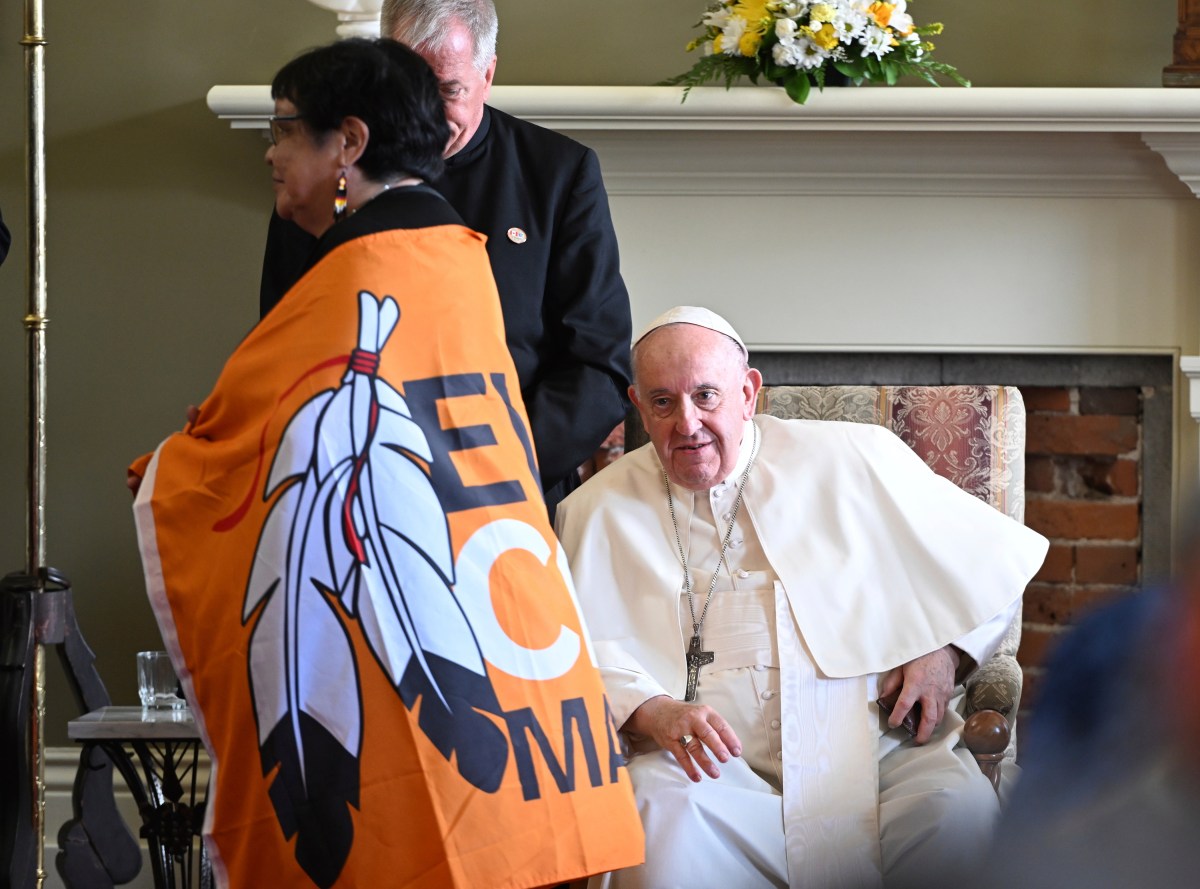
Francis, the first-ever Latin American pope, knows the history well. Last year, he travelled to Canada to personally apologize to Indigenous peoples for abuses they endured at the hands of Catholic missionaries at residential schools.

In the run-up to the visit, Indigenous groups visited the Vatican’s Anima Mundi museum, saw some of their ancestors’ handiwork, and expressed interest in having greater access to the collection, and the return of some items.
“The restitution of the Indigenous things is underway with Canada — at least we agreed to do it,” Francis said, adding that the Holy See’s experience meeting with the Indigenous groups in Canada had been “very fruitful.”
Indeed, just a few weeks ago in another follow-up to the Canada apology, the Vatican formally repudiated the “Doctrine of Discovery.” This theory, backed by 15th-century “papal bulls,” was used to legitimize the colonial-era seizure of Native lands and forms the basis of some property laws today in the U.S. and Canada.
Francis recalled that looting was a common feature during colonial-era wars and occupations. “They took these decisions to take the good things from the other,” he said.
He said going forward, museums “have to make a discernment in each case,” but that where possible, restitution of objects should be made.
“And if tomorrow the Egyptians come and ask for the obelisk, what will we do?” he said chuckling, referring to the great obelisk that stands at the center of St. Peter’s Square. The Roman Emperor Caligula brought the ancient obelisk to Rome more than 2,000 years ago, and it was moved to the square in the 16th century.
The Vatican Museums are mentioned in the 2020 book “The Brutish Museums,” which recounts the sacking of the Royal Court of Benin City by British forces in 1897 and the subsequent dispersal in museums and collections around the globe of its famed Benin Bronzes.
In the appendix, the Vatican is listed as one of the museums, galleries or collections that “may” have objects looted from Benin City, in today’s Nigeria, in 1897.
The Vatican Museums hasn’t responded to requests for information. The Nigerian Embassy to the Holy See, asked recently about the claim, said its “contact in the Vatican is currently looking into the issue.”

