
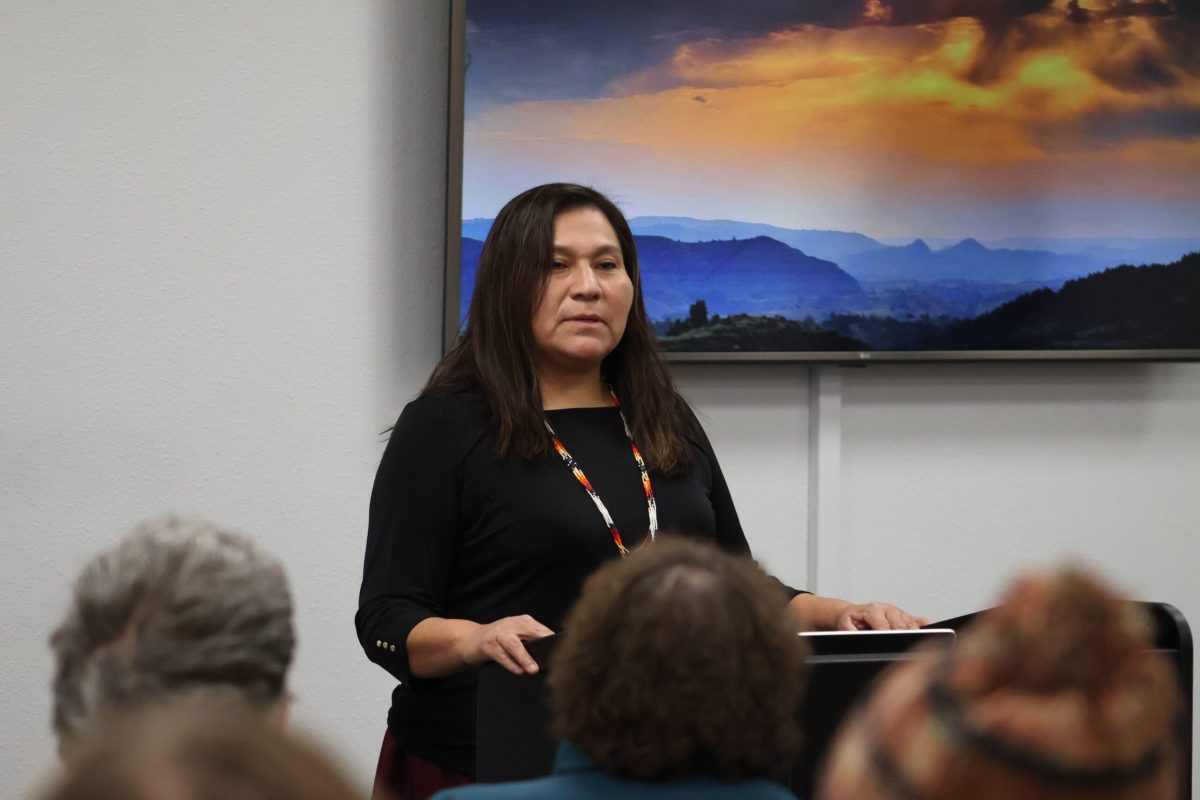
Kalle Benallie
ICT
On Jan. 13, the U.S. Supreme Court rejected to overturn a district map that allows Native voters in North Dakota to select their own candidates. It’s a victory for Native voting rights and representation.
“The MHA (Mandan, Hidatsa and Arikara) Nation is pleased that the Supreme Court has upheld North Dakota’s voter redistricting legislation. The legislation gives the MHA Nation a voice in the state legislature by redrawing fair districting voting lines. This win strengthens the civil rights of every citizen in the state and allows rural and reservation voters an equal opportunity to elect the person they want to represent their community in the state legislature,” Mandan, Hidatsa and Arikara Nation Chairman Mark N. Fox said. The nation is also known as the Three Affiliated Tribes.
The Campaign Legal Center, Native American Rights Fund and the Law Office of Bryan Sells represented the Mandan, Hidatsa and Arikara Nation and individual voters in this case.
“The right to vote is sort of the foundation of everything that follows. If we don’t have political leaders who don’t understand tribal sovereignty and who understand the needs of Indian Country, we won’t get policies that respect tribal sovereignty, uphold it and ensure the best results for Native Americans,”said Lenny Powell, Native American Rights Fund Staff Attorney Lenny.
Powell, a citizen of the Hopland Band of Pomo Indians, said although the legal battle was not easy, a majority conservative Supreme Court does not mean an unfavored outcome for tribes.
“Today’s example is one of many that rebuts those type of claims,” he said.
The North Dakota House District 4A encompasses the Fort Berthold Reservation in North Dakota. In 2021, the Mandan, Hidatsa and Arikara Nation requested the state legislature to create the subdistrict to preserve the tribal nation as a community of interest and contain a majority Native voting age population, as required by the Voting Rights Act.
In 2022, two North Dakota voters filed a federal lawsuit, Walen v. Burgum, against North Dakota’s Gov. Doug Burgum and Secretary of State Alvin Jaeger challenging the state’s legislative redistricting plan as an unconstitutional racial gerrymander.
The Mandan, Hidatsa and Arikara Nation, individual voters Lisa DeVille, and Cesar Alvarez, Jr. joined the lawsuit as defendant intervenors.
A week before the Spirit Lake Tribe and the Turtle Mountain Chippewa also filed a federal lawsuit against North Dakota’s Secretary of State challenging the state’s enacted legislative redistricting plan as diluting their reservations’ voters’ voting strength, violating the Voting Rights Act.
In November 2023, a panel of judges in the U.S. District Court for the District of North Dakota ruled in favor of the tribal intervenors.
“Protecting the new MHA subdistrict was important because we have fought so hard to be able to exercise our right to vote in North Dakota. Native people simply must vigilantly defend every gain we achieve as voters,” Alvarez said.
In May 2024, voters and the tribal nation urged the U.S. Supreme Court to dismiss the lawsuit or to uphold the U.S. District Court’s ruling that found in favor of the tribal nation and the state of North Dakota.
The North Dakota Attorney General Drew Wrigley asked the Supreme Court to throw out the legal victory and remand Walen v. Burgum back to the U.S. District Court for further review.
“The Supreme Court’s ruling generally is a continued vindication of the importance of the Voting Rights Act which requires legislatures to ensure all voters have an opportunity to elect candidates of their choice, which was critical here to the North Dakota legislature drawing a boundary that respected the reservation boundaries and that ensured there was a right to vote,” Powell said.

Our stories are worth telling. Our stories are worth sharing. Our stories are worth your support. Contribute today to help ICT carry out its critical mission. Sign up for ICT’s free newsletter.

