Pauly Denetclaw
ICT
SAN DIEGO — Indian gaming is always evolving. When a state, law or court case says no, tribal leaders find a different way and develop a new solution.
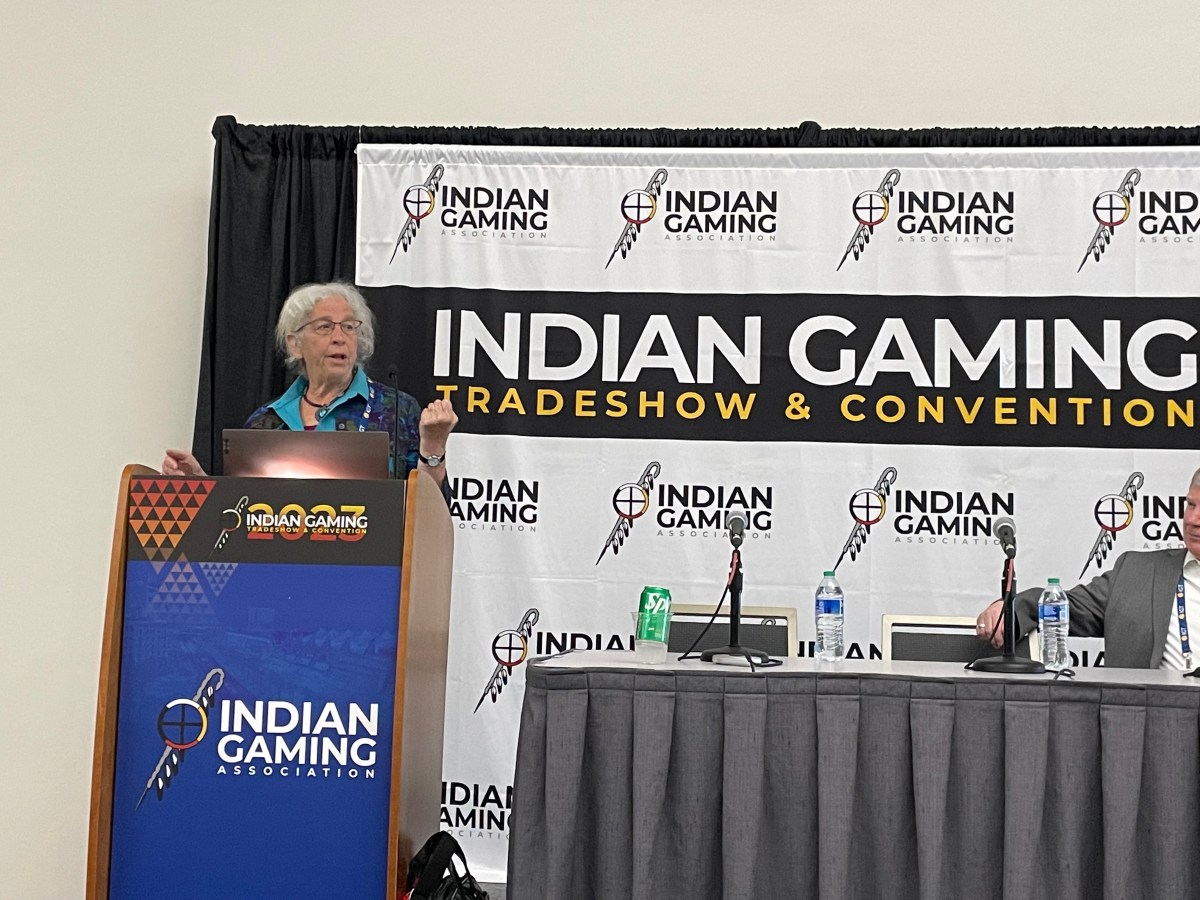
“Indian gaming did not start with the Indian Gaming Regulatory Act,” said Judith Shapiro, an attorney with 30 years experience in Indian law. “Gaming was started by tribal leaders who didn’t ask permission. They opened up high-stakes bingo, in places where bingo was otherwise legal and said ‘you can’t regulate us.’”
From there Indian gaming went from a $100 million industry in the early days to a multi-billion dollar industry today. There are 515 tribal casinos operated by 250 different federally recognized tribes in 30 states.
Of all the tribal gaming states, Indian gaming has a combined economic impact totaling $105 billion. Indian gaming accounts for nearly 50 percent of the entire gaming industry and its gross revenue, $39 billion, reached an all-time high in fiscal year 2021.
Indian gaming is also credited with continuing to be innovative in the industry, pushing forward everything from cashout vouchers, cashless facilities and Class II gaming, essentially bingo.
The Indian Gaming Regulatory Act defines Class II gaming as “the game of chance commonly known as bingo.” But the key part of the act comes after that line and states, “whether or not electronic, computer, or other technologic aids are used in connection therewith.”
In the late 1980s, the first electronic bingo machines hit the market and changed the game for Indian gaming. While not the best user experience, it would soon provide a way for Indigenous nations, located in states hostile to Indian gaming, a way to operate and engage in economic development.
In an industry that values slot machines and card games, it may seem counterintuitive to focus on high-stakes bingo but there are issues with reauthorization of gaming compacts. In an unprecedented move, the Rincon Band of Luiseño Indians earlier this year withdrew from their gaming compact with California over regulatory costs mandated by the state and is in the process of transitioning their casinos to Class II gaming facilities.
Class II gaming paved the way for Indigenous owned and operated Las Vegas-style casinos that offer slot machines and table games. How so?
“When my tribe opened up their casino in 1995, we had all these great market machines and we couldn’t get a deal with the state of California,” said Victor Rocha, Pechanga Band of Luiseño Indians and president of Victor Strategies, referring to his personal experience during a panel at this year’s Indian Gaming Convention in San Diego. “Governor Pete Wilson said we’re not going to renegotiate a contract with you. You are going to have to sign this deal or there’s no deal whatsoever. Without Class II, we wouldn’t have had the resources to fight these guys. We didn’t have the resources to have lawyers or what it would have taken to have the attorneys fight our case at all levels.”
Gaming compacts with states that are required in order to have slot machines and table games, require money, lawyers, lobbyists and so much more.
“Class II is the commercialized gaming that tribes can do without interference by the states,” Shapiro said.
Tribes can participate in commercialized bingo in states that allow it without a state gaming compact and they don’t have to share revenue with the state either. This is why many tribes opt to have only electronic bingo machines that look almost indistinguishable from slot machines. This type of gaming also created a direct relationship with the Indigenous nation and the federal government. Class II facilities are regulated by the National Indian Gaming Commission not the state.
The Pokagon Band Gaming Commission, located in Michigan and Indiana, has used Class II gaming as a tool to become one of only five Indigenous nations who hold a certificate of self-regulation from the National Indian Gaming Commission. This certificate allows the Pokagon Band Gaming Commission to self-regulate their own gaming facilities in Michigan and Indiana with very little, if any state oversight.
Other Indigenous nations who participate in gaming are subject to state oversight.
The self-regulation certificate is only for Class II gaming facilities. It’s a long, arduous process to obtain a certificate but is worth the effort according to Bruce Molnar, commissioner for the Pokagon Band Gaming Commission.
“It’s most important because it is self determination and absolutely it is sovereignty,” Molnar said. “We are the regulators of gaming in our part of Indian Country.”

ICT is a nonprofit news organization. Will you support our work? All of our content is free. There are no subscriptions or costs. And we have hired more Native journalists in the past year than any news organization ─ and with your help we will continue to grow and create career paths for our people. Support ICT for as little as $10. Sign up for ICT’s free newsletter.