
This article was originally published by the Cherokee Phoenix.
D. SEAN ROWLEY
Cherokee Phoenix
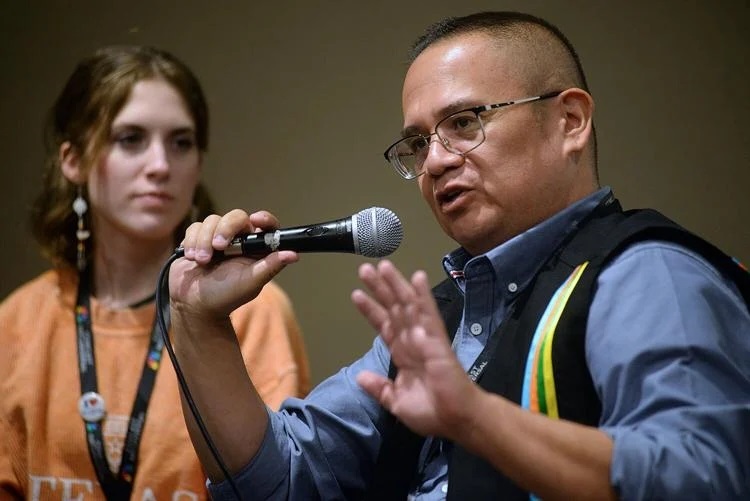
ALBUQUERQUE, New Mexico – Troy Littledeer, a journalist who lost his job after challenging tribal censorship, received the 2025 Tim Giago Free Press Award from the Indigenous Journalists Association during ceremonies at the Isleta Resort and Casino.
Littledeer, a member of the United Keetoowah Band of Cherokee Indians and former media director for the tribe, was honored for his commitment to press freedom after facing termination for refusing to accept editorial interference with the Giduwa Cherokee News.
“I wrote a story. It was a news story. Someone didn’t like it. I was censored. I was fired,” Littledeer said during his acceptance speech on Aug. 15.
The Indigenous Journalists Association recognized Littledeer’s “steadfast commitment to press freedom within his tribal community” and noted that his pushback against political censorship came at significant personal cost.
“The Special Awards Committee recognizes Littledeer’s unwavering dedication to freedom of the press and the public’s right to know, especially when that truth is challenged from within,” IJA said in a statement.
Littledeer, who has more than two decades of journalism experience, began his career in 2003 covering local sports for the Stilwell Democrat Journal. His work has included contributions to NDNSports.com, public relations work for Cherokee Nation Communications and multimedia production at the Cherokee Phoenix.
During his acceptance speech, Littledeer said his experience reflects broader challenges facing tribal media across Indian Country.
“What I’m learning is that my situation is not uncommon in Indian Country,” he said. “We struggle for our stories to be told anyway, and we can’t let censorship cover that up.”
In an interview following a panel at the annual IJA conference, Littledeer said he was nominated for the award by Krystan Moser, who works for Cherokee Nation Businesses and is a close friend.
“I was surprised I won because I do believe it is a major issue for Indian Country, not just Cherokee Nation, UKB, Eastern Band, whatever,” Littledeer said. “I feel like for Indian Country, kind of like what we discussed in this panel, how do we remedy that for everybody?”
Littledeer participated in a panel discussion about press freedom challenges in tribal media, where he met other Indigenous journalists facing similar censorship issues.
“Even after the guy, he was Hopi … he said he’s going through the same issue on his little tribal newspaper,” Littledeer said. “So, learning things, I know I’m not alone in facing this. I feel like we’re going to have to organize to figure out how to resolve it for all of us.”
The award comes as Littledeer considers legal action against his former employer. He said he is preparing to file a petition pro se, using the Indian Civil Rights Act as part of his case.
“Every attorney that reads them says the same thing … ‘you’re 102 percent right, but unfortunately, you’re not going to win,’” Littledeer said.
The termination had immediate consequences for his family. Littledeer said losing his insurance affected his two sons, Tobias and Sequoyah, who require occupational and physical therapy twice weekly.
“Those two little boys, they took my insurance away,” he said. “When I lost my insurance, we went two months without it. So, two months of twice-a-week gone, and we almost had to start all over again.”
During his acceptance speech, Littledeer thanked his wife Novena and his sons, calling them his daily inspiration “to stay grounded in culture, responsibility and to uplift all of Indian Country.”
The Tim Giago Free Press Award honors individuals who demonstrate extraordinary efforts to uphold freedom of information and transparency in Indigenous media. It was established following the 2022 passing of Giago, who founded the Native American Press Association in 1983, which later became the IJA.
Littledeer called for greater separation between tribal governments and media outlets, emphasizing the importance of protecting fundamental rights.
“We need to teach these people why we’re voting, what they voted on, how it affects us,” he said. “These are fundamental rights that everybody’s entitled to. Not just UKB, not just Cherokee Nation. All of Indian Country.”

