
This story was originally published by Daily Montanan.
Micah Drew
Daily Montanan
Two lawsuits filed in federal court seek to overturn a new policy by the Bureau of Land Management revoking federal grazing permits for bison herds in Montana.
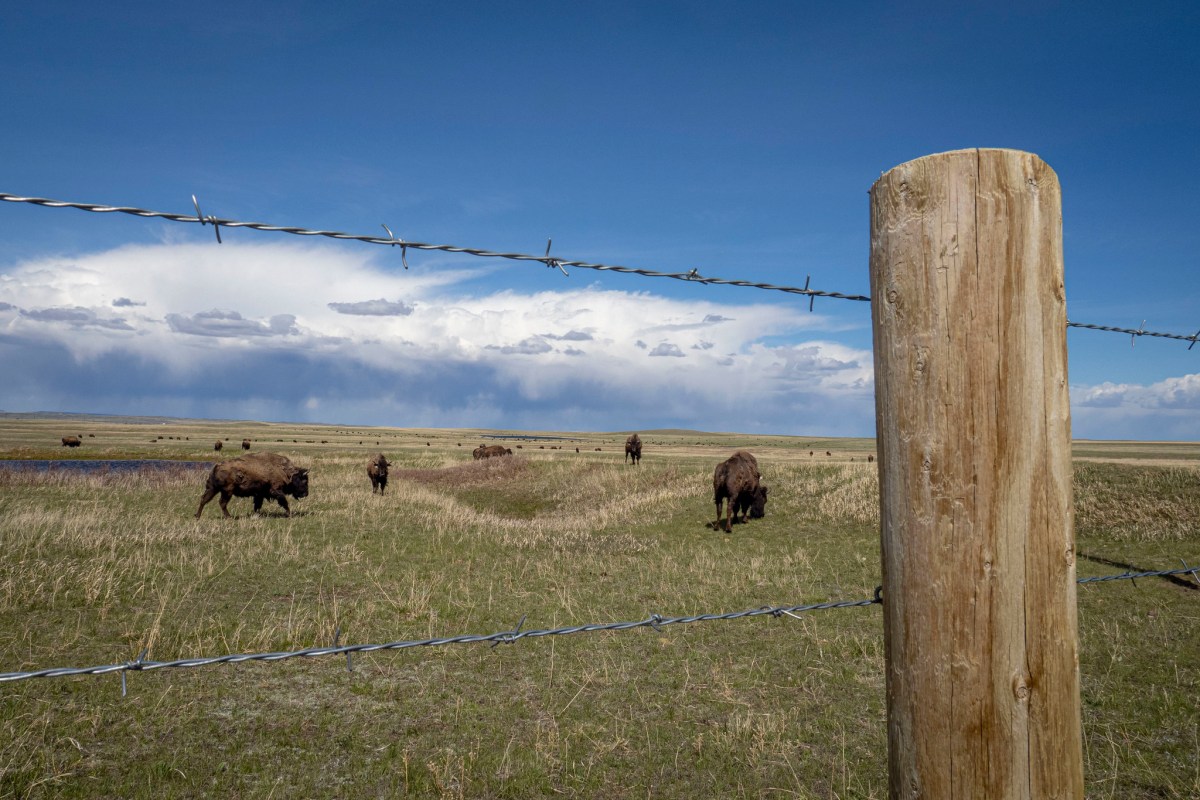
American Prairie, a conservation organization that owns and leases vast swaths of land in eastern Montana, has grazed a herd of more than 900 bison on federal land for more than 20 years.
But late last year, the Trump administration’s Department of the Interior began a process of reviewing the federal leases.
In May, the BLM canceled six of American Prairie’s permits, comprising more than 60,000 acres, using a new interpretation of the federal Taylor Grazing Act that livestock be “production-oriented” in order to use federal land.
“For more than 20 years, we’ve demonstrated that bison can be responsibly managed on public lands while improving the health of Montana’s prairie,” said Alison Fox, CEO of American Prairie. “Our record is clear. This case isn’t about whether we’ve been good stewards — we have. It’s about whether the federal government can abandon decades of settled law and change the rules to reach a different political outcome.”
American Prairie appealed the agency decision, which was denied, and filed its lawsuit on Aug. 4 seeking a temporary restraining order and preliminary injunction against the revocation of its grazing permits.
The organization currently has until Sept. 30 to remove its bison herd from the federal land.
A spokesperson for the BLM said the agency does not comment on pending litigation.
When the federal government announced it was proposing to cancel the leases, multiple conservation organizations and Native American tribes pushed back against the new interpretation, saying it would be detrimental to the environment and could hinder Indigenous rights and tribal bison herds.
One organization, Western Watersheds Project, filed its own lawsuit with the Western Environmental Law Center on Aug. 5, calling the new decision a “politically motivated reversal” that ignored years of environmental review and public input.
“The Trump administration is kicking our national mammal off of public lands, and trying to replace bison—an ecological keystone of prairie ecosystems—with cattle, which causes a huge amount of ecological damage,” Erik Molvar, executive director of Western Watersheds Project, said in a statement.
Bison vs. Montana
Bison grazing in Montana has long been a contentious, and often political, issue, with concerns raised by the ranching community.
One concern is about bison carrying the disease brucellosis and passing it onto cattle — though most of the state, outside the Yellowstone National Park region, is considered free of the disease. Another is that American Prairie is taking land from agricultural production — a stance the organization rebuts, in part because it leases much of its own land to cattle producers.
But Montana’s all-Republican federal delegation, and its statewide Republican officials have also long opposed bison grazing.
Gov. Greg Gianforte and the delegation asked Burgum to take a look at the bison leases, saying the organization’s mission is at odds with the state’s economy, and echoing concerns that it is removing agricultural land from use.
The state Department of Natural Resources and Conservation has also been at odds with American Prairie over proposed leasing of state land for bison grazing.
American Prairie sued the state for slow-rolling the review process last year, and more recently sued again to stop a Montana Land Board policy blocking DNRC from approving new and pending grazing requests. The organization won a preliminary injunction in the latter suit last month.
In court
In American Prairie’s federal case, the organization argues that the reversal of a decades-long understanding of the Taylor Grazing Act is a targeted attack on its herd.
“BLM’s new interpretation of the Taylor Grazing Act unlawfully created qualifications for grazing applicants not found in the statute’s text,” the lawsuit states. “Therefore, the agency’s statutory interpretation is arbitrary, capricious, an abuse of its discretion and otherwise not in accordance with the law.”
According to court documents, American Prairie estimates it will need to cull at least 300 bison from its herd in order to comply with the Bureau’s ruling, which could harm the genetic diversity of the herd, and expose animals to “increased risk of disease and injury during handling and transportation.”
In addition, the lawsuit argues that the “about-face policy change” hurts the organization’s ability to plan for future herd management and interrupted business contracts.
Part of American Prairie’s legal case rests on the process BLM conducted to grant five new, and two existing, bison grazing permits in 2022.
Following the application process, BLM conducted public scoping and completed a 180-page environmental analysis, according to court documents.
The agency stated that “the productivity, or non-productivity, of livestock or privately owned or controlled animals is not a factor for issuing grazing permits,” a stance it defended when Montana appealed the permitting decision.
Even under the new interpretation, American Prairie argued in its complaint that some of its herd is used for production, including that it holds an annual public harvest, has yielded 75,000 pounds of bison meat for public consumption, and contributes hundreds of bison to tribal food sovereignty programs.
“BLM arbitrarily invented a ‘production’ qualification for grazing permittees, requiring the agency to probe applicants’ intent and business model,” the lawsuit states. “And BLM did not provide a reasoned explanation for its determination that American Prairie’s conservation mission and public messaging disqualified it from grazing its animals on public land.”
American Prairie’s lawsuit names Burgum, the Department of the Interior, BLM and Stevan Pearce, the Bureau’s director, as defendants.
Western Watersheds’ federal case, filed against just the Bureau, argues the Bureau failed to explain the new interpretation of the Taylor Grazing Act, and failed to conduct a detailed review under the National Environmental Policy Act, which was done before the 2022 approval of American Prairie’s leases.
Western Watersheds is asking a judge to vacate the decision altogether.
