
Miles Morrisseau
ICT
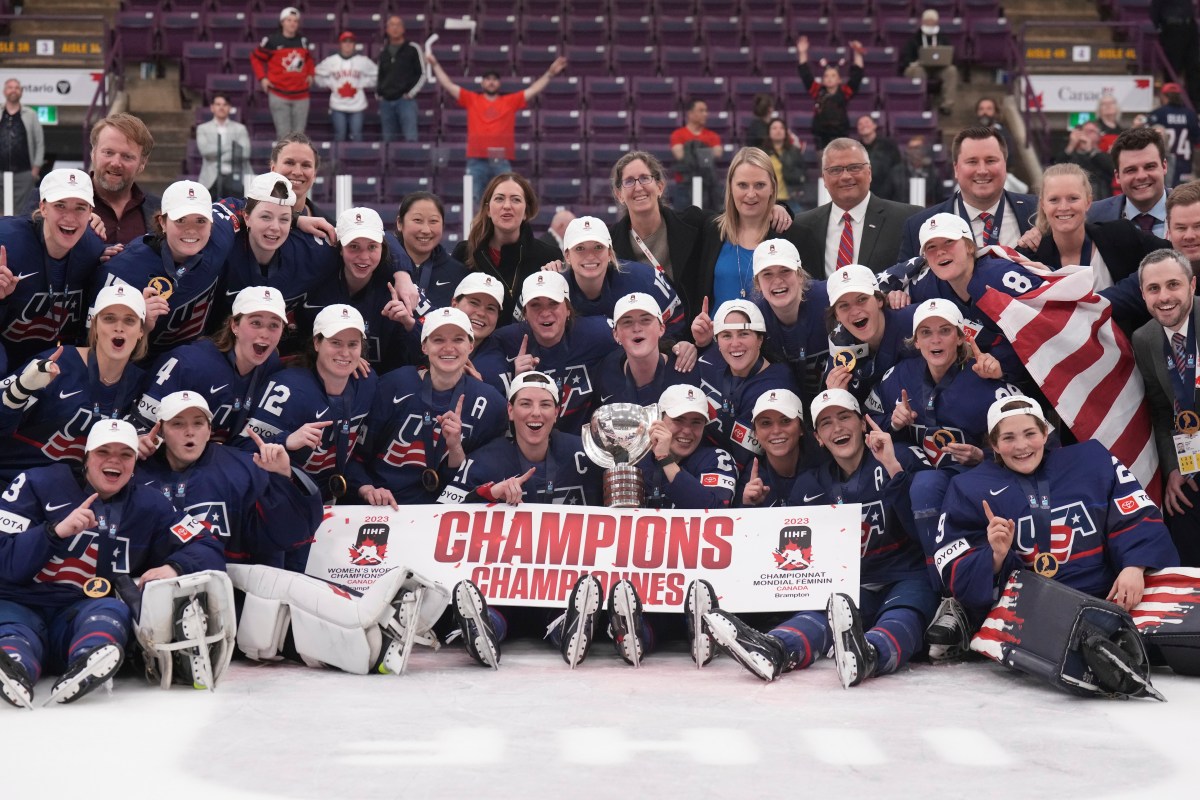
The greatest rivalry in women’s international ice hockey has been settled — for now — at the IIHF World Women’s Ice Hockey Championship, with Team USA taking gold with a decisive 6-3 victory over Canada.
Abby Roque, Ojibway from Wanahpitae First Nation, was a key part of the victory and was able to bring home her first gold medal since joining the national U.S. team. It marks the 10th international championship gold medal for the Americans and the first in four years against rival Canada.
SUPPORT INDIGENOUS JOURNALISM. CONTRIBUTE TODAY.
Roque, who grew up in Sault Ste. Marie, Michigan, has been on the women’s hockey team since 2020, and took home silver in the 2022 Olympics after the U.S. lost to the Canadians. She also had to settle for silver at the world championships in 2021 and 2022.
This year, however, Roque is wearing gold, despite being held off the score sheet in the final game. She finished second in scoring with nine points and had the best plus/minus among Team USA forwards.
“It’s hard to beat Canada. It’s hard to beat Canada in Canada, right? So we definitely felt like an underdog,” Hilary Knight, the U.S. team’s star player, said after the game. “People are always rooting against us, but somehow we persevere and it feels sweeter that way. ”
Read more:
—Olympic hockey: Indigenous women stand out in gold-medal game
The two Indigenous women on the Canadian team, Jamie Lee Rattray and Jocelyne LaRocque, both Métis Nation, took home silver medals.
The championship game, played in Brampton, Ontario, just outside Toronto, was established by the International Ice Hockey Federation in 1990. Team Canada was undefeated in the gold medal game up until 2005, when Team USA took home the hardware.
Since then the Americans have been dominant in the tournament, winning 10 of the last 15. Team Canada, however, won the last two and was looking to three-peat at home.
Going for gold
This year’s tournament in Ontario was filled with a Canadian-friendly crowd looking to sing the national anthem at the end of the gold medal game.
The crowd got what they wanted at the start, with Marie-Phillip Poulin — nicknamed Captain Canada — scoring the first goal.
The U.S. tied it up before the end of the first, and earlier in the second Rattray assisted on a Brianne Jenner goal to put Canada back in front.
At the end of the second period, the Canadians were leading 3-2 and it looked like another close game. The last five World Championship gold medal games have been decided by a single goal.

But the third period was all USA.
Caroline Harvey for Team USA scored early to tie the game, and then Knight scored her second and third of the game. Cayla Barnes added an empty net goal to close the door.
The smaller but vocal pro-American fans chanted, “USA, USA,” and sang the national anthem with great enthusiasm.
Winning awards
Ten countries competed in this year’s tournament, including Czechia, which took home bronze, along with Switzerland, Finland, Sweden, Japan, Germany, Hungary and France.
Canada’s LaRocque, the long-time stalwart on defence, was again the leader in ice-time for Team Canada, clocking in 23 minutes and 15 seconds over 38 shifts.
Rattray, who finished the tourney with four points, was recently selected as APTN’s Bryan Trottier Most Valuable Indigenous Player Award for 2023. The award, named after the New York Islanders great, is awarded for excellence on the ice and for giving back to the community. Trottier, also Métis Nation, won four Stanley Cups as a New York Islander and two for the Pittsburgh Penguins.
Roque, LaRocque and Rattray are all members of the Professional Women’s Hockey Players Association, which advocates for the development of a “single, viable professional women’s ice hockey league in North America that showcases the greatest product of women’s professional ice hockey in the world.”
This article contains material from The Associated Press.

Our stories are worth telling. Our stories are worth sharing. Our stories are worth your support. Contribute $5 or $10 today to help ICT carry out its critical mission. Sign up for ICT’s free newsletter.
