

“Me. We.”
– Muhammad Ali at his Harvard commencement speech after the audience asked him for a poem, June 1975
Mark Wagner
Special to ICT
SANTA ANA PUEBLO, New Mexico — The eve before the 5th Native American Open, generations of Native golfers from two countries, 23 states, and 67 nations, bands and tribes gathered at Santa Ana Pueblo.
Jay Garcia, chairman of Santa Ana Golf, had arranged for a warm-up match, a kind of dream, a Round with Legends. Elite golfer and grand-nephew of Jim Thorpe, Robert Komahcheet lll, Comanche, joined with lifetime Professional Golfers Association Steve McDonald, Potawatomie, Garcia and me in a nine-hole match.
“I’m a better writer than a golfer,” I warned my partner, Komahcheet, before we faced off against Garcia and McDonald. In fact, I had been encouraged by more than a few folks to take up bowling rather than golf.
Nevertheless, I agreed to the stakes. Losers would fork over a signed dollar bill.
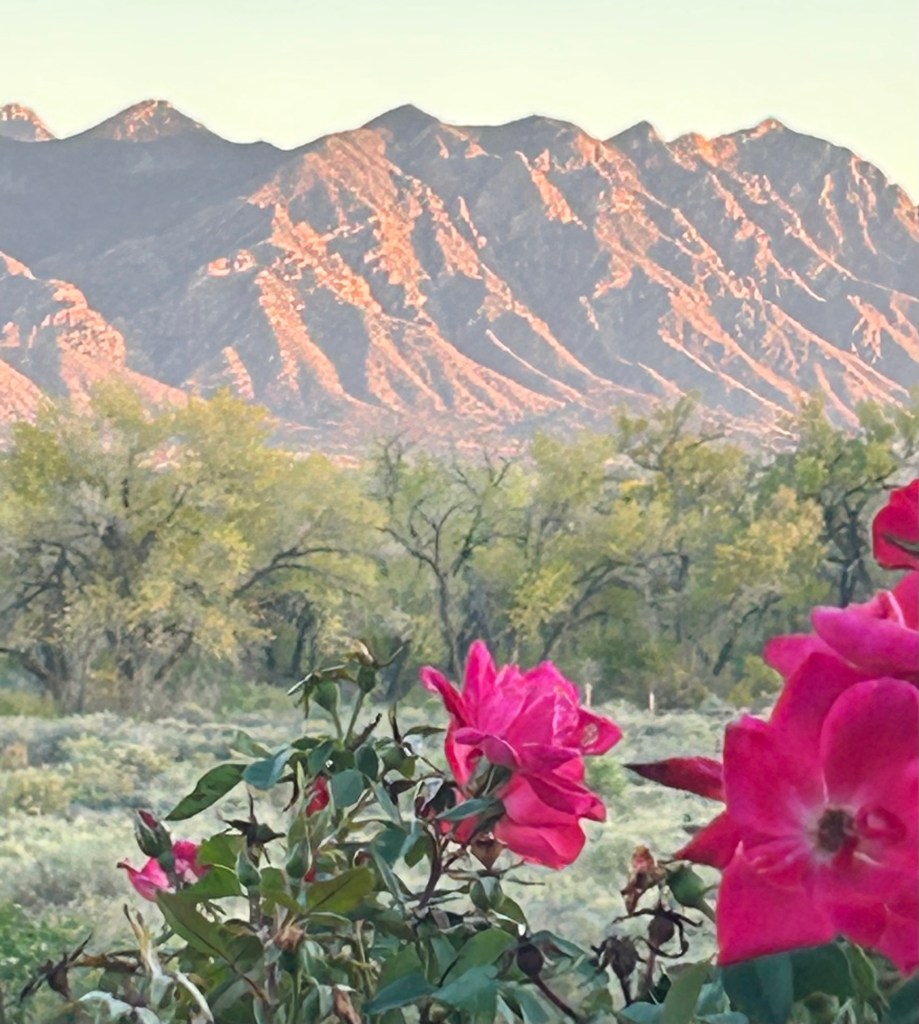
“To be framed,” McDonald pointed out to each of us with his sure-fire smile. If I didn’t have much of a game, I had a dollar. The sun was shining at 70 degrees, and we had run of one of New Mexico’s finest courses — the combined work of the Creator and human labor. A subtle work of art.
I had been writing about golf history for many decades when, in 2022, a project arose that became a matter of necessity. Writing about Lake of Isles, I interviewed the architect, Rees Jones, as well as the historian of the Mashantucket Pequot Tribe, Lori Potter. These interviews led to questions: How many tribes own and operate golf courses? Who were the Native players in golf’s history?
A conversation with my editor, Jim Sitar, at Back Nine Press outlined the project.
“This history needs to be written,” he said, “and if you want to write it, have at it.”
He also suggested the challenge would be getting out of the way and letting Native voices shine through. With this in mind, it came to be, a White guy born in Paterson, New Jersey – someone who would be told by Native golf instructors that I “needed a miracle” to fix my swing – would write a first comprehensive history of Indigenous roots in golf. It became the book, “Native Links, The Surprising History of Our First People in Golf,” published by Back Nine Press in 2024.
I was retired from a career in education, and the research and travel and learning became a passion, a necessity, a story that needed to be told. Even after the book was published, I continued to write about Natives in golf, and returned in October for the third time to cover the Native American Open, for Notah Begay III’s Grande Slam, and for a round with these three giants.
My continued interest in Natives in golf led to another question: Before we set off that morning, Garcia asked about my interest. It was not unfriendly, still, he asked, “What’s in this for you?”
I had no answer.
More than a century ago
The tradition of Native Americans in golf begins with Oscar Smith Bunn, Shinnecock Montauk, who played in the 1896 and 1899 U.S. Opens. This has been more than good fun to point out to the golfing world that the first American to represent the nation at the U.S. Open was Native.
In both 1896 and 1899, he played the U.S. Open alongside his friend, a Black man, John Shippen.
My journey included meeting Oscar’s nephew, David Bunn Martine, Shinnecock, Apache, a fine artist who had studied with Rauschenberg and Charles Peele Wilson. Together with the historians at the U.S. Golf Association, we negotiated for a portrait of Oscar Bunn — painted by David — to hang in the USGA Hall of Fame in Pinehurst, North Carolina.
When we began, Bunn was in the World Caddy Hall of Fame, a gross distortion of his place in golf, an injustice which the portrait has corrected on some level.
And the surprises did not stop with Bunn. Native heritage in golf runs through Frank Dufina, Chippewa, and Althea Gibson, Lumbee; Joe Louis, White, Black and Cherokee; and Orville Moody, Choctaw; and through Rod Curl, Wintu; Michelle Wie, Hawaiian; and Ricky Fowler, Navajo. It also goes through legions of unsung devotees to what I call “the least violent and most difficult game of human history.”

Aided in part by the Gaming Act of 1988, more than 70 tribes now own their own golf courses, some of them destination golfing and gaming and dining destinations. In turn this has given access to a new generation of athletes and professionals, many of them gathered at Santa Ana that October weekend.
Begay’s NB3 Foundation has nurtured a slew of young golfers accessing education and internship programs – kids like the Long Sisters and Beans Factor. The PGA and USGA had recently opened its doors through internship programs that have given career lifts to many, including Taylor Harvey, Navajo and Hopi; Faylyn Beyale, Navajo; and Shandiin Harper, also Navajo. Others – such as Begay and Gabby Barker Lemieux – have become household names.
‘No coincidences’
To the east of where the Santa Ana and Twin Warriors golf courses are laid into the earth, the Sandia Mountains make for a late sunrise. As we gathered for our friendly two-ball, in the crisp morning light, McDonald honored Garcia, Komahcheet and I with gorgeous and thoughtfully-beaded key chains with story bands wrapped around the key ring.
As McDonald handed out the gifts, Garcia spoke up.
“I want to show you something,” Garcia said, taking his keychain out of his pocket. Frayed and shredded, it looked like it had spent a few years in a washing machine on thrash.
“I have been waiting to replace this for some time,” Garcia said “Now I know why I waited.”
“No coincidences,” McDonald said. “There’s no such thing.”
A Lifetime PGA member and winner of one of the PGA’s highest honors in 2022 — the Deacon Palmer Award, named for Arnold Palmer’s father) — McDonald is one of the first, if not the first, Native American to gain lifetime PGA membership. He is also the first Native golfer to connect the game of golf with the divine.
“Golf is about enjoying the beauty of what the Creator of All Things has laid out in front of you,” he said. “The grandfather rocks, the unpredictable wind that comes from every direction, the amazing sun.”
McDonald is the instructor who told me I needed a miracle to fix my swing. I also needed instruction on grandfather rocks.
“The grandfather rocks?” he said. “They teach us that all things are connected and interwoven with everything else in the universe, whose vastness is incomprehensible.”
Robbie and the rattler
Another thing beyond comprehension is the golf swing and ability of Robbie Komahcheet —a giant of a man with a gentle smile. I’m 66 and have – literally — begun to shrink. Playing alongside Komahcheet, whose resemblance of his great-great-uncle is uncanny, I felt like I might fit inside the palm of his hand.
In the intense, desert sun, one could easily imagine that the space-time bubble had burst and I was walking beside Thorpe himself. Having known Komahcheet three years, I was comfortable with his presence and asked him about a story I had once heard: That at the 1912 Olympics in Sweden, before he ran the 1500, Thorpe had his sneakers stolen.
“That is true,” Komahcheet said. The story has been passed down in the Thorpe and Komahcheet line as an example of their relative’s greatness, but also of Native American resilience and ability.
In “Path Lit by Lightning: The Life of Jim Thorpe,” released in 2022, Pulitzer Prize-winning author David Maraniss interviewed many who verified the story. Thorpe’s running shoes “went missing” before the 1500-meter race. He borrowed one shoe from a teammate and found another in a trash bin. Despite the theft of his shoes, he won the race and Olympic Gold.

“His sure will to compete,” Komahcheet said. “I would read about him in books and just imagine how great he was. He was a true warrior and role model for me and all Native kids growing up.”
Komahcheet and McDonald knew each other from Native golf circles as younger men in the late 1990s and early 2000s. They share laughter, smiles and fist bumps as they recall together the stories of hard-fought victories, famous courses and other players, looking to break into the pro ranks. This journey is exceedingly difficult even without the challenges that came with being a Native American at the turn of centuries.
For McDonald, family duties intervened. For Komahcheet, addiction.
“Thank you for telling my story,” he said. “It’s not over.”
Komahcheet is not shy about his struggles. He is intent on helping young Native athletes avoid the pitfalls that he and Begay and many others have struggled through, generational struggles that have followed Natives since the days of the Trail of Tears, the Indian Wars, and into a history our country continues to both acknowledge and try to correct. He has confided in me about how hard it was to be an alcoholic, the loneliness of that time in his life.
He is now 10 years sober and strives to be a role model, akin to his uncle.
“To just be a person that everyone looked up to, like my great-great-uncle,” he said. “I know without God I would never have the opportunity. Being sober has opened many doors for me. I know I would never have been able to have a chance to meet you if it wasn’t for God in my life.”
Komahcheet’s vulnerability only deepens my respect for his athletic ability, an ability that shined that day on the 14th tee at Twin Warriors, a hole high up along the ridge of a mesa. The rich green of the fairway was framed by layers of time in the red and orange of sandstone.
We watched Komahcheet hit one of his prodigious drives, one that sailed in and out of eyesight before there was a flash as only golfers sometimes see – a splinter of light. We were all awestruck by the shot, and then twice again when we drove through a little valley to find Komahcheet’s ball pin high – he had hit a drive 390 yards, an event that I would not have believed had I not been there. And there’s more, not only did he chip in for an eagle two, there on the green, as if waiting for us, sunning itself as if a guest on a lounge, was a baby rattlesnake.
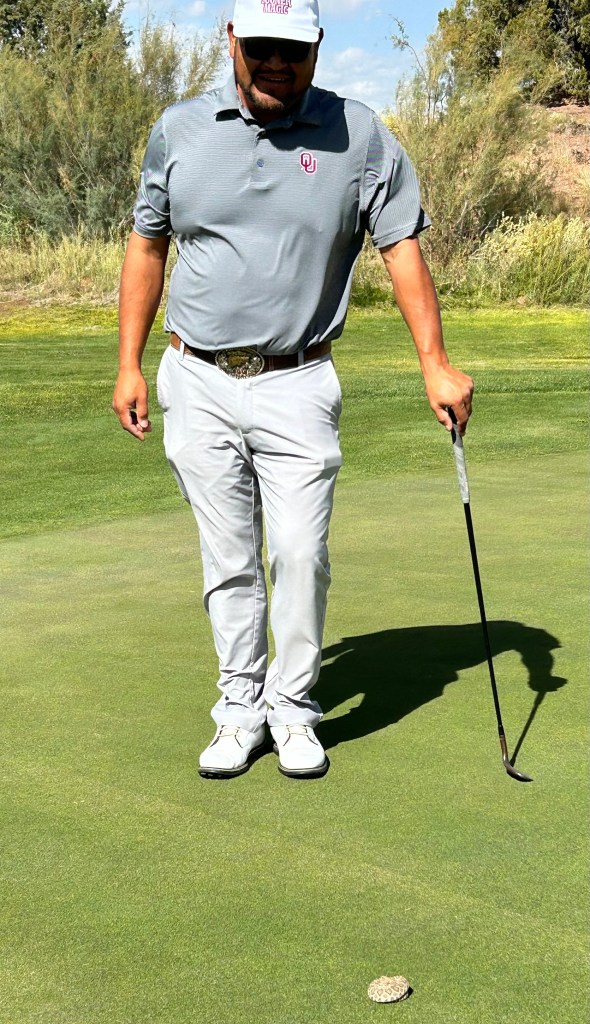
In some Native traditions, the rattlesnake is a symbol that blends warning, transformation, and renewal.
“People don’t know how hard that life is, how lonely,” Komahcheet once told me about the years he spent in addiction. He had transformed, with the help of his father and mother, with his great-great-uncle.
“My mom (a Thorpe) was my biggest influence on my recovery. Her faith in God and prayers guided me through. Coming up on 10 years sober and I couldn’t be happier,” he said.
Komahcheet’s excellence also allows for lighter moments. McDonald noted that it took me three strokes to catch up to one of Komahcheet’s. We all laugh. And a few steps on, I ask Komahcheet about his swing, where the power comes from. In addition to showing me how he “fires his right hip,” he adds, “My swing comes from courage. That is my heritage. To be brave.”
The greatest story ever told?
My round with these legends morphed into a weekend of competitions and events. (Komahcheet and I won the two-ball!) Through it all, I continued to grapple with Garcia’s question – what’s in this for you? In fact, at a reception that evening, Garcia reminded me that I hadn’t answered his question. “I’m still waiting,” he said.
Over dinner, I mentioned how I end my presentations on “Native Links,” by saying, “The recovery of Native cultures would be one of the greatest stories in American history.”

On this point, Garcia cautions me.
“My grandparents talked about The Great Depression. It was reported that people lost everything. They would tell us, we didn’t lose anything. . .. We still had our cows, pigs, sheep and the garden. We had our rituals and culture. All of this stood the test of time,” he said.
The pueblos, as is true of the Apache and the Shinnecock and others, have held on to their original territories, even if they are greatly reduced. This is not the case for many other tribes who were forced from ancestral lands. The Rez is loaded with stories of economic and physical and mental decline, and it is this I refer to when I talk of recovery, the economic recovery afforded by the Gaming Act of 1988, which in turn led to a surge in Native participation, now 70+ golf courses, some of them destination resorts.
This more recent history of recovery is what I refer to, and Garcia agrees this has been a good thing.
“We’re busting at the seams,” he said, and then he repeated himself. Santa Ana Golf and Twin Warriors are as busy as golf operations get.
To demonstrate the vitality of their golf and the pueblo’s operations, between meeting and greeting and golfing and eating, Garcia drives me over to the community center, built in 2015 with the proceeds from Santa Ana Golf and other enterprises.
The community center — called the Tamaya Wellness Center — had a state-of-the-art pool and fitness center, a food distribution program, and in the all-purpose room, where a couple of dozen young people aged 4–12 were settled into their after-school routines of study and snacks. His tour of his pueblo included showing me the adobe house where he grew up and introducing me to his sons and sisters.
By visiting Garcia’s childhood home, his question about motivation stayed fresh. This journey was about friendship and golf, yes, but something more, a deeper understanding was moving, even as words came hard.
When Garcia and I returned to the festivities of Begay’s Grande Slam, a fundraiser for the NB3 Foundation, I reached down and picked up a heart-shaped rock. My wife and I have a ritual: whenever we are apart for a long period, we look for a heart-shaped rock as a gift and way to declare our love. That day, holding my earth-colored stone in the late-rising New Mexican sun, I had begun to see how the recovery of Native culture — through golf and other enterprises — is about economy, yes, but also about something more cherished. It’s about what McDonald had been telling me all along, recovering the idea that all things, even in the most remote place and time, are connected.
That is the teaching of the grandfather rocks. My heart-shaped rock is a grandfather rock, and a grandmother rock, for that matter. When you pick up a stone, you are holding something connected to all things in the entire universe. This knowledge comes with responsibilities, of care, of respect and honor of our mother, the earth. The necessity of this journey, my connection to these gifted and beautiful athletes, what was in it for me was in it for “we,” for all of us. In this dark time in America, and in facing our past truthfully, we all seek a return to a deeper connection to the earth, to the sacred and the more sacred, and a return to each other.
As more than 250 golfers gathered for Begay’s Grande Slam, I bumped into professional golfer Gabby Barker Lemieux, once the #1 collegiate golfer in the country and still pursuing her dream of being the first Native woman to win on tour.
I had interviewed her for “Native Links,” but this was my first face-to-face meeting with her — a tall, beautiful and talented athlete. I asked how her journey was going. Behind an irrepressible smile, she said, “Golf has taken me places I only dreamed of, but what I love most is these raw, in-between moments that make this journey so special.”
It was just after dawn and the sun, sliding over the Sandia Mountains, began to bathe us in a clear light. Hundreds of us gathered to support NB3 and celebrate Natives in golf. We were in that moment outside our devices, beyond the machine, in real connection and care. And we were ready to take on the least violent and most difficult game of human history — golf.
