
Pauly Denetclaw
ICT
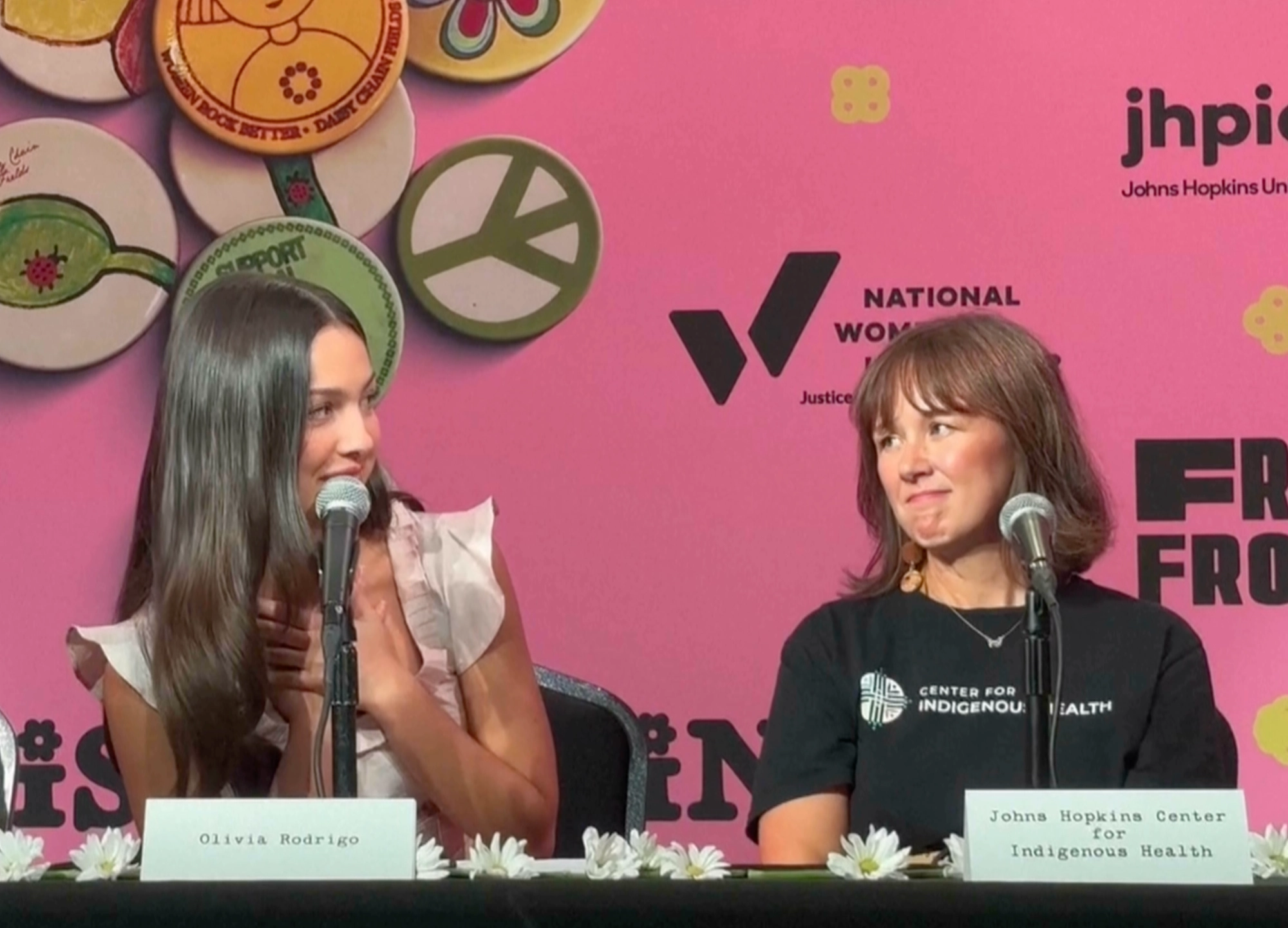
It came as a shock when the Center for Indigenous Health, housed at Johns Hopkins University, was selected as one of 10 recipients for a $1 million donation by grammy award-winning popstar Olivia Rodrigo. It was very timely since the center was one of 53 organizations whose funding for teen pregnancy prevention was terminated in late June. A total loss of more than $1 million in program funding.
“Our center is a place that is like a nonprofit within a university, while we sit within the infrastructure of a university, we rely on grants for everything — for funding staff, funding programs,” Melissa Walls, Center for Indigenous Health co-director, told ICT. “We were really nervous and in fact have had several large federal grants cut over the past year and a half. (We) have really turned to philanthropy and private donors to try to fill some gaps. So to get a call and hear that we were going to get an influx of what turns out to be about $2 million to support mission critical programming — there were tears, there was celebration and we could not be more grateful.”
Through Daisy Chain Fields, a one-day music festival featuring only women in music, Rodrigo raised $10 million. The net profits will be given to 10 organizations that advance and advocate for women and girls. It was later doubled to $20 million after Melinda Gates, founder of the Gates Foundation, matched Rodrigo’s fundraising.
The center isn’t entirely sure how it was discovered by Rodrigo, but they do have a theory.
“It’s still a little bit of a mystery to us,” Walls said. “We can’t say for sure, but we think that someone in philanthropy who happened to work with a Hollywood producer who heard about our center during COVID, then went to work with someone connected to Olivia Rodrigo. It all relates to relationships, I guess they must have said good things about us. We think that’s how this happened, but we can’t say with certainty.”
Three of the biggest popstars in the world — Rodrigo, Chappell Roan, and Doechii — all performed for free. There were 14 other women in the concert lineup including music and cultural icon Stevie Nicks.
“Words cannot describe how grateful I am for their time and their passion about this festival. The women performing tomorrow and those sitting beside me today inspire me so much” Rodrigo said during an Aug. 28 press conference. “They’ve taught me a lot about how we are all stronger when we come together and support one another. And that’s actually why I fell in love with the name Daisy Chain. It served as a reminder of how individual parts can come together to create something strong and unbreakable. It’s easy to be discouraged by all of the sadness and regression of women’s rights in our world today, but it’s artists like the one playing tomorrow and activists like the one sitting next to me today that give me so much hope. And I hope Daisy Chain can be a celebration of the love and determination that these women are putting into making this world a better place.”
In the next couple of months the Center for Indigenous Health will be receiving the $2 million donation.
The center already has five major programs that serve women and girls.
“Our Family Spirit program is home visiting and has been around for decades and has this beautiful evidence base of an Indigenous-built program to serve new moms,” Walls, Couchiching First Nation and Bois Forte Band of Ojibwe, said. “Outcomes of that program have shown drastic improvements in maternal and child outcomes over the long term.”
Home-visiting programs are voluntary, and help first-time parents navigate caring for a newborn with guidance from nurses or licensed social workers. Everything from where to place a crib to monitoring development and breastfeeding.
There are several other programs under the Center for Indigenous Health that have been impacted by federal funding cuts and grant terminations.
“We also have vaccine programs that are really under attack right now,” Walls said. “We have a canoe migration journey here where I live in Minnesota, a collaboration with a group called Hartberry House, which is an Indigenous-run nonprofit. We’re really trying to reclaim women and non-binary community members’ connections to water and our canoe ways. We know that culture is healing medicine.”
The center is also planning to create a Daisy Fund, named in honor of Rodrigo. In the mission statement for Daisy Chain Fields, Rodrigo states, “Daisies are wild and beautiful. As a chain they are strong and unbreakable.”
It would provide seed funding for grantees who are focused on creating “stronger futures for women and girls,” Walls said.
