Meghan Sullivan
Indian Country Today
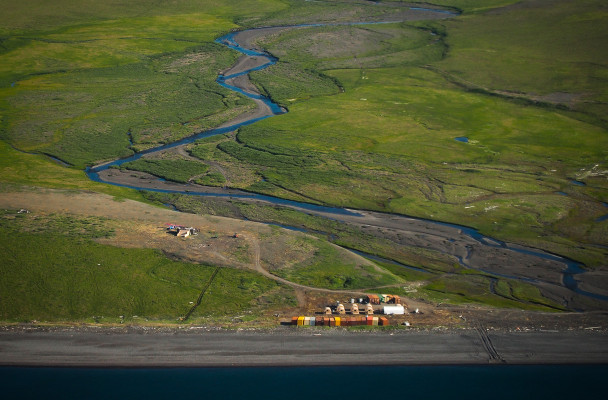
When a string of Yup’ik elders from St. Lawrence Island, Alaska, all received the same cancer diagnoses, officials initially shrugged it off as a bizarre medical mystery. But not long after, a different village reported an increase in unusual cancer symptoms as well. Then another case struck. Hours away in Unalakleet, several locals were diagnosed with Parkinsons, a rare disease for Alaska Native populations.
It was becoming clear that these grim trends weren’t a coincidence. Upon further investigation, all three villages had unknowingly been consuming contaminated drinking water and food.
“Emotionally, it cuts you to the core,” said Delbert Rexford, Inupiaq, president and CEO of Ukpeaġvik Iñupiat Corporation, the village corporation for Utqiagvik, the nation’s northernmost community. “My cousins, my aunts and uncles have been a part of that.”
Rexford has been advocating for the cleanup of contaminated lands for the past few decades. It’s a challenge that many Alaska Native leaders are familiar with.
When the Alaska Native Claims Settlement passed into law in 1971, 44 million acres of Alaskan land were promised to Alaska Native regional and village corporations. As it turned out, a significant portion of these lands were contaminated prior to their conveyance — berries poisoned and harvests tainted by long forgotten war relics abandoned on the outskirts of Alaska Native villages.
“Let me be clear: under ANCSA, Alaska Native people gave up 88 percent of our traditional lands. In exchange, we received, in part, contaminated sites that we may be legally liable for,” Sarah Lukin, Alutiiq, said in a 2017 testimony on the issue.
Pollution and chemical runoffs aren’t exactly what most people would expect to find in Alaska’s wilderness, especially in the remote areas where affected villages are located. The explanation lies in an often overlooked chapter of the state’s past.
Alaska served as a critical military outpost from World War II through the Cold War. It was an ideal location for strategists — the region was close to Russia yet still U.S. territory, it had large stretches of wilderness perfect for training, and there was little regulatory oversight. Somewhere between a reliable homebase and a foothold abroad, Alaska drew the attention of the sharpest military minds of the day.
Simple combat drills soon turned more ambitious. In 1958, the U.S. government planned to explode an atomic bomb in the Arctic, just 26 miles away from the Inupiaq village Point Hope. The proposal, coined Project Chariot, was intended to create an instant harbor in the frozen coastal region.

Leaders across the state widely supported the initiative. Alaska had joined the union just one year earlier, and many residents hoped the nuclear blast would ignite a new era of economic opportunity.
The neighboring Inupiat village however, was not sold on the idea. To spread word of the upcoming detonations, local Inupiaq artist Howard Rock founded Tundra Times, the first Alaska Native newspaper. It would go on to become an organizing powerhouse, and later set the stage for ANCSA itself. Armed with support from the state’s other Indigenous cultures and joined by a handful of defecting U.S. Atomic Energy Commission scientists, the Point Hope community was able to successfully halt Project Chariot.

Unfortunately, remnants of these covert Cold War era missions remain. Still in the early days of statehood, there wasn’t extensive protocol for military withdraws. Chemicals, equipment, and weapons were simply left behind — sometimes with a sign that warned of their danger, but usually with no notice at all.
Today, chemicals such as arsenic, asbestos, lead, mercury, pesticides, and polychlorinated biphenyls are still found in rural Alaska. Many of these contaminants are linked to illnesses, such as cancer and Parkinsons.
To make matters worse, multiple contaminated sites are found on traditional subsistence lands, locations that Alaska Natives have harvested for centuries. Part of the ecosystem for decades now, some of these toxins have seeped into the food chain. For example, recent study discovered that marine life near affected areas contain significant amounts of PCBs.
It’s a particularly unjust situation. Families go to harvest in areas that are known for nourishment and generational gathering. Years later, they find out that these abundant lands had been endangering them all along.
“What’s happening on our traditional lands… it’s hard to fathom. We do continue to harvest, but are there contaminants out there that we don’t know about?” Rexford asked. “Only studies will show.”
In recent years, melting permafrost has unveiled new dangers. As temperatures rise and the geography shifts, more unidentified landfills, debris, and equipment are starting to appear.
The list of incidents keeps growing: sharp cables emerging from riverbanks, thousands of crushed barrels rising out of the tundra, a landfill discovered in a lagoon valued for beluga harvesting.
“We haven’t even come to scratch the surface of what is really there,” Rexford said.
‘There’s a lot of finger pointing’
According to a 1998 U.S. Department of the Interior report, at least 650 of these sites were known to be contaminated at the time of their conveyance. Around a third of the contaminated areas were Formerly Used Defense Sites, known as FUDS.
The U.S. Department of Defense is responsible for cleaning the Formerly Used Defense Sites, in accordance with the Comprehensive Environmental Response, Compensation and Liability Act. However, they are not responsible for cleanup of privately owned defense sites, which technically includes any land conveyed under ANCSA.
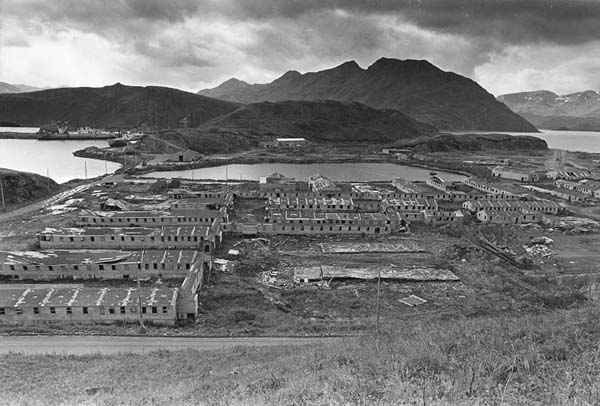
As people grew sick, and more attention was brought to the contaminated sites, Alaska Native communities faced an additional problem: they were now responsible for cleaning up toxic land that they had not contaminated themselves, per the legal dynamics.
“It is damaged goods, effectively. And you are a small, small village, and you’re up against the federal government saying, ‘Hey, don’t you have a responsibility to clean this up before you give it to us?’ It is truly a situation that is daunting,” said Alaska Sen. Lisa Murkowski in a 2020 interview.
It’s not a minor cost. The Alaska Native Village Corporation Association estimates Alaska Native corporations would have to spend at least $6 billion to complete the cleanup of all of these locations.
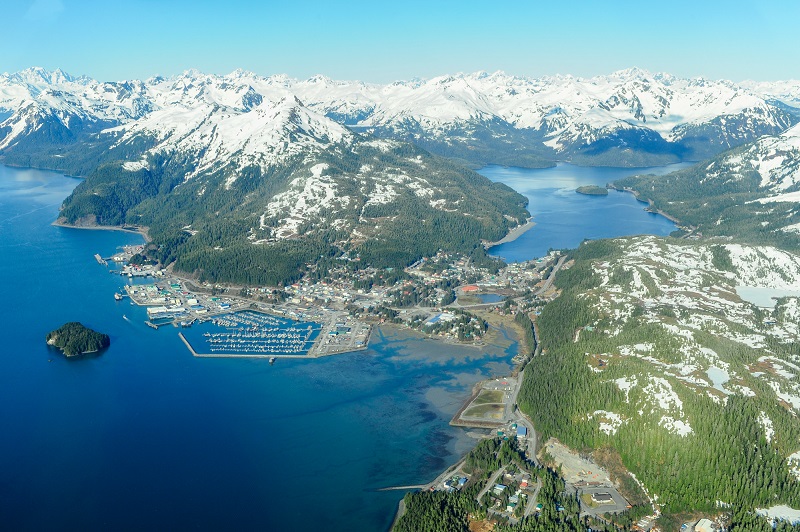
“In return for the extinguishment of Aboriginal rights to these lands, the federal government gives us lands that are contaminated, then they make us clean it up? Everybody agrees, that’s going a little too far,” said Brennan Cain, Vice President and General Counsel Eyak Corporation, the village corporation for Cordova, a small southern Alaskan community near Prince William Sound.
All parties involved recognize that the situation is unfair. The challenge isn’t proving the need for a clean up — it’s determining who is responsible for it.
The Department of the Interior’s Bureau of Land Management is in charge of transferring ANCSA conveyances to ANCs. They aren’t in charge of cleaning the conveyances, but they also can’t transfer lands that are known to be contaminated. The Bureau says they were uninformed about any contaminated lands they had previously handed over. Meanwhile, the Alaska Department of Environmental Conservation and the Environmental Protection Agency oversee the physical clean up. However, they aren’t liable for the contamination, so they aren’t expected to cover the costs. Technically, the original entity that damaged the land is supposed to fund the cleanup. But this information isn’t always available, and around 100 sites don’t have their past owners identified.
“There’s a lot of finger pointing,” said Cain.
The debate is still occurring today.
In May 2021, Alaska Gov. Dunleavy sent a letter to President Biden, requesting that the federal government complete the required cleanup of hundreds of contaminated sites found on ANCSA lands.
“It has been 50 years since ANCSA became law, and the cleanup of contaminated lands has yet to be addressed,” said Kim Reitmeier, executive director of the Alaska Native Corporation Regional Association, in the governor’s press release.
Reitmeier’s statement summarizes the frustration many feel about this topic. The sites have been identified, the negative impacts have been witnessed, and everyone agrees it’s a problem. So what will it take to get rid of contaminated lands?
Next generation needs to ‘pick up the mantle’
It’s been decades since the government first acknowledged the poisoned lands, but Rexford doesn’t believe the surprises have ended.
His region has a reason to be wary.
In 1990, a series of government documents from the 60s became declassified. They revealed that radioactive soil had been buried underground near Point Hope after Project Chariot was shut down. By the time locals were informed of this, it was too late – the effects had taken root. Today, cancer is still the leading cause of death in the village.
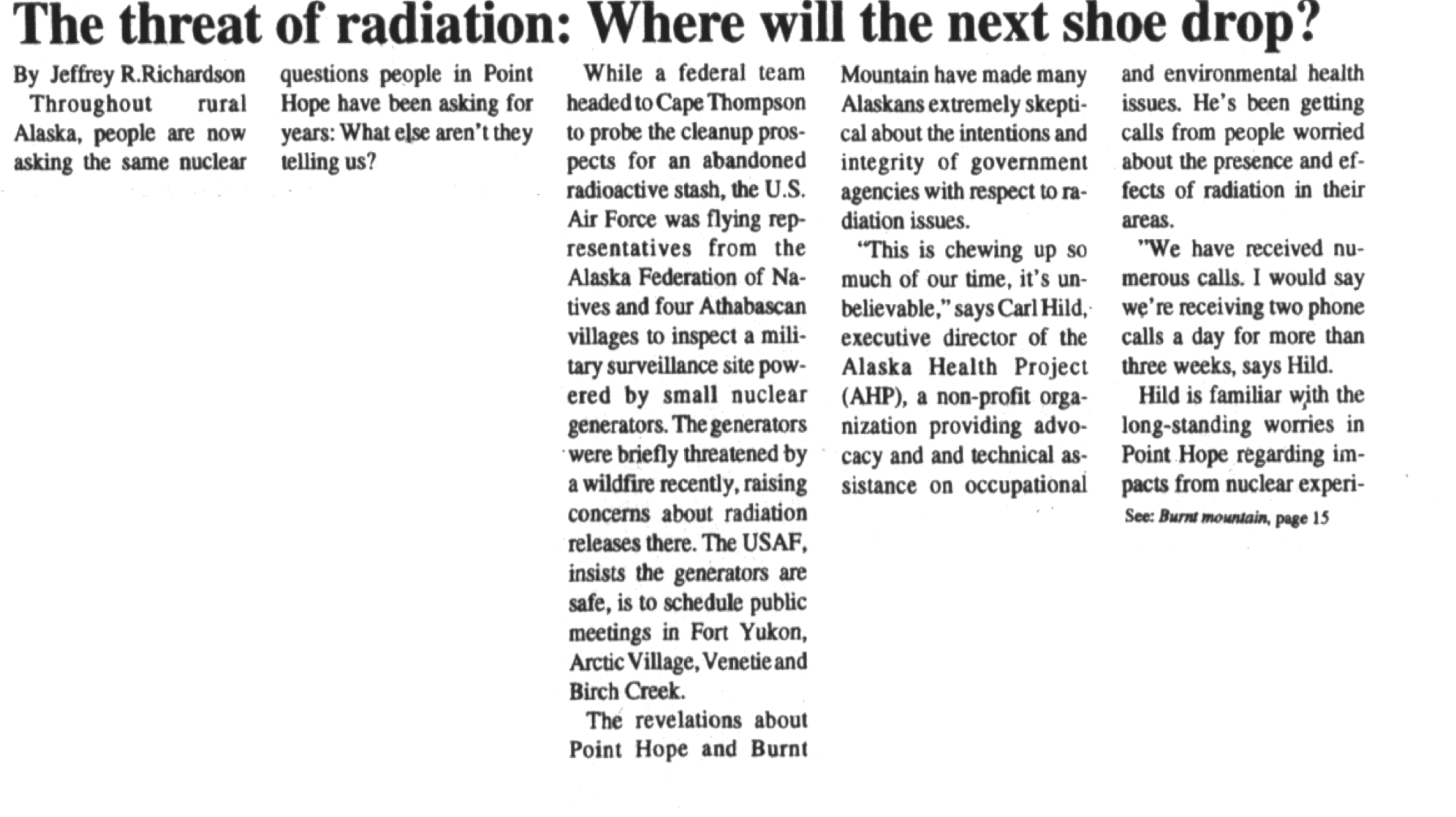
The community fears more cases like this could occur if extensive clean up measures aren’t implemented in the near future.
There has been some progress over the past few years. In 2018, legislation was passed that amended CERCLA, to ensure that Alaska Native Corporations would not be held liable for the contaminated sites.
Other organizations have helped where they can as well, such as the Bureau of Land Management.
“The BLM working cooperatively with all stakeholders and using four databases from Alaska Department of Environmental Conservation developed a comprehensive Contaminated Lands Inventory to aid in cleanup prioritization. More than 6,000 sites were reviewed resulting in 94 sites identified with an additional 104 sites as possibly containing contaminated lands,” said Lesli Ellis-Wouters, communications director for the Alaska Bureau of Land Management.

It’s a strong step in the right direction, but Cain fears the momentum will fade.
“There’s been some progress, but we need to keep going. It’s such a huge issue,” said Cain. “And at this rate, it’s literally going to be 100 years before all these sites get cleaned up.”
Thirty years ago, it appeared the situation had been solved. A resolution was passed, with concrete steps to address contamination. But after the initial excitement around the announcement died down, people slowly forgot about the issue. In the end, only minor changes resulted from the well thought out plan.
Today, there are now additional obstacles to consider.
For one, this problem has been around for so long, that many of the go-to experts are starting to retire. Most of this task force has been somewhat volunteer based, working outside of the regular job description and hours, so there aren’t direct replacements for the roles. As the original advocates begin to leave the scene, new leaders will have to step in to take their place.
“The next generation of folks need to sort of pick up the mantle,” Cain said.
There is also the issue of coordination.
Future advocates might find success in establishing a lead department to oversee clean up. One option would be the Army Corp of Engineers, which is already in charge of removing the Formerly Used Defense Sites.
Cain also recommends increased logistical planning between regions. Sites could be ranked by order of importance based on subsistence use and village proximity. Regional leaders could then determine the most efficient route for the equipment to be transported.
Employment opportunities from the operation could go to local Alaska Native shareholders, suggests Rexford. The training they would receive from these roles could be applied to other cases as well.
“It’s our homeland. It’s under our feet. And we want a sense of ownership in cleaning it up,” he said.
Even with all logistics in place, one major challenge would still remain: there isn’t enough funding. With clean up costs in the billions and tight federal budgets, the government isn’t likely to foot the entire bill anytime soon.
However, outside funding initiatives could make a difference. Putting capital toward the cleanup effort is a direct way for nonprofits, such as environmental justice initiatives, to assist. Their impact would be visible, immediate, and in many cases, life saving.
As Rexford prepares to begin another year advocating for the ANCSA conveyances to be cleaned, he reflects on the circumstances. Despite their small population, his community has been able to raise awareness about an injustice that threatens thousands across Alaska.
But that’s part of the problem. Something tells Rexford that more populated areas of the United States wouldn’t have been left to face nuclear waste and cancer causing toxins alone for this long.
“What about a community of 800 that is exposed to some of these elements that are life threatening? Don’t they deserve equity? Don’t they deserve the same level of environmental justice that our brothers and sisters to the south receive?” he asked. “Or are they just termed as being expendable? As collateral damage?”

This story is part of Indian Country Today’s series on the 50th anniversary of the landmark Alaska Native Claims Settlement Act. Funding for ICT’s ANCSA project is provided in part by the Alaska Center for Excellence in Journalism. Stay updated on ICT’s ANCSA project using #ANCSA50 and at https://indiancountrytoday.com/tag/ancsa-50.
Our stories are worth telling. Our stories are worth sharing. Our stories are worth your support. Contribute $5 or $10 contribution today to help Indian Country Today carry out its critical mission. Sign up for ICT’s free newsletter.