
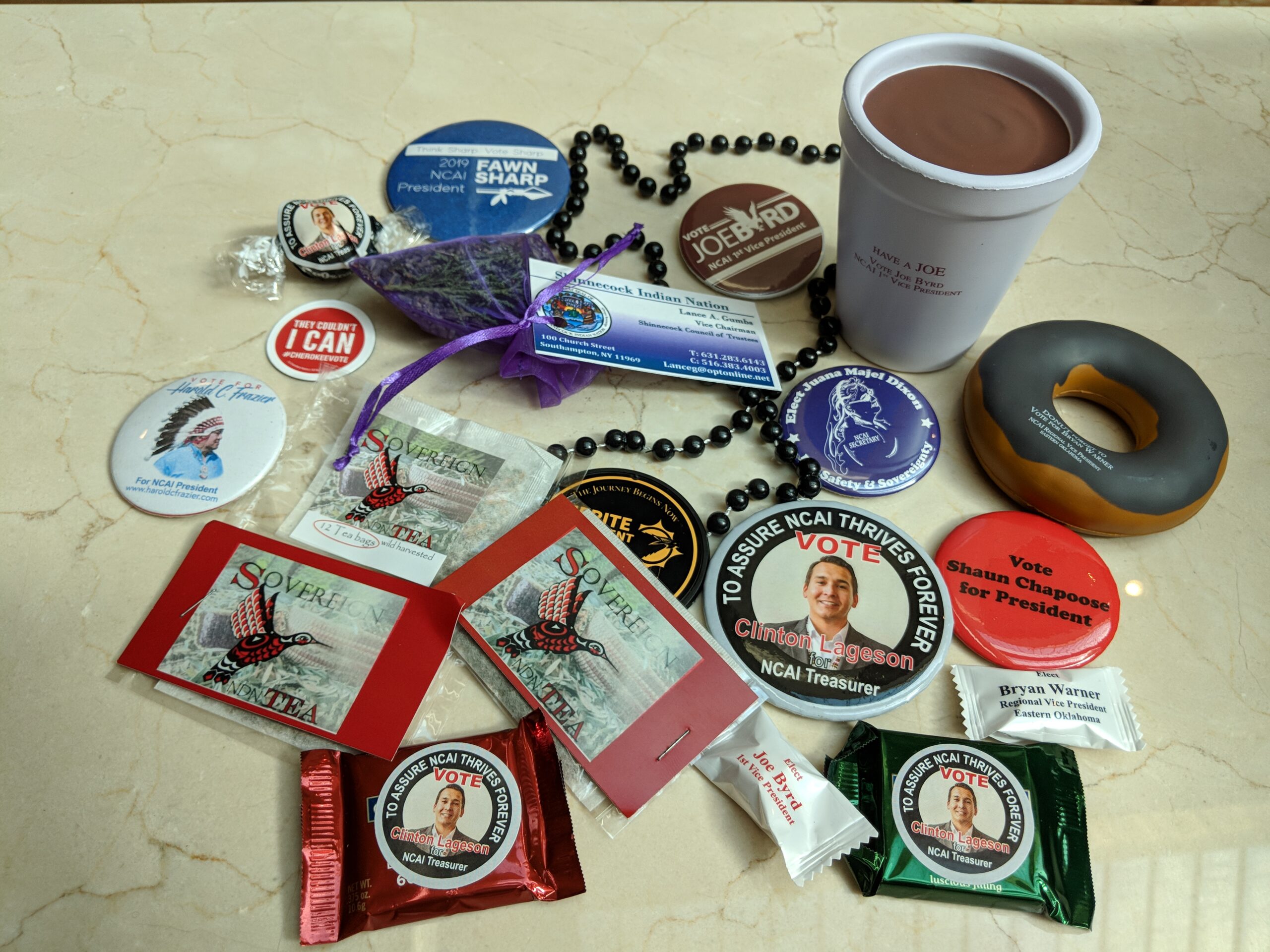
Bite size chunks of bison are placed near boxes of doughnuts and chocolates with a candidates name stuck on the wrapper are offered to voters by campaign staffers eager to share their candidates’ name and platform.
There are four candidates running for the office of president of the National Congress of American Indians, a position held by Jefferson Keel for the past decade. Keel also served as the First Vice-President from 2005 to 2009. Keel is the former lieutenant governor of the Chickasaw Nation of Oklahoma and he’s a retired Army officer.
Now Shaun Chapose, former chairman of the Ute Indian Tribe along with Harold Frazier, chairman of the Cheyenne River Sioux Tribe, Fawn Sharp, president of the Quinault Indian Nation and finally Marshall Pierite, chairman of the Tunica-Biloxi Tribe of Louisiana are all hoping to be the Congress’ next president.
In addition to electing a president, members will also vote for a first vice president, a recording secretary, treasurer and a number of other regional offices.
The campaign swag is clever.
Anyone up for a cup of ‘sovereign-tea?’ How about a fake cup of coffee or a chocolate covered doughnut? Both cute and useable as squeezable stress relievers.
And there’s the usual stickers, pens and even t-shirts that are being handed out to voters.
Vanessa Brown, council member of the Pauma Band of Luseno Indians, is a newly elected tribal leader. “Well this is my first time coming to NCAI and I was just as surprised at all the giveaways, that’s a lot of money, time that they’re giving towards it,” she laughs.
She’s still weighing her options. “I need to know they’re working for everybody, not just their own tribe. It’s got to be for everybody, collectively.”
Mark Mitchell, is the former governor of the Pueblo of Tesuque. He’s a lifelong member of the congress. He’s seen some campaigning in the past.
“I think the issues are more intense in this election. I hope we get a good candidate that will move NCAI in a forward direction that will benefit all the tribes.”
Mitchell has been attending the annual conference since 1993. He has not yet decided on a candidate. He does know what he wants the new president to focus on once elected. “The new leader in my opinion should be more motivated to be on the hill advocating for the tribes of this organization and tribes in general and to make sure that they address issues right at hand and not wait a couple of years to address them but they should address them right up front, as soon as they occur, they should address them.”
Sophia Salgado, council member of the Pauma Band of Luseno Indians, says she wants Indian Country to be recognized because there are so many issues. “We need to be visible in order to be seen and be heard. I think that’s one of the things we need to work on.”
Jack Hopkins is from Eyak, Alaska. “It’s interesting,” he says of all the campaign freebies which are not impressing him enough. He plans to read up on the candidates.
He did figure out a different use for the fake coffee cup which he’s taking home. “I thought it would be a good prank to pull on my grandchildren. I can tell them I’m having a cup of coffee and I’ll kinda spill it on them and they will jump and shriek and start laughing.”
After laughing, he reconsiders the freebies.
“We’ve been assimilated, now in 2019, to the point where we feel that accepting gifts is going to allow people to buy us.” He may not have seen the purple bag of sage being handed out by another candidate.
Martin Javier, president of the Salt River Pima Maricopa Indian Community, has attended the conference for 12 years. “It seems like the candidates are kinda going kinda way out from what I’ve seen in the past as far as trying to get themselves out there to members of NCAI and letting people know who they are. I’ve never seen, and maybe I’ve missed it in the last 12 years, but I’ve never really seen campaigning like I’ve seen here this year with all of their materials that are out there, their booths that are set up promoting their views.”
He notes the many issues facing tribes including education, foster care, and children being adopted out of tribes.
“I would just hope that Washington hears us at some point and that’s what I want leadership to do, the leadership from NCAI somehow need to get the message out on some of our needs.”
Irene Cuch is Ute Indian. “Oh gosh, I joined NCAI back in 1969.” She’s served on her tribal council off and off since then and has been active in the congress through the decades.
“I would say, there’s quite a few running.” They had fliers and buttons but she hasn’t seen any specific campaign giveaways.
Cuch rattles off a list of concerns she would like to see addressed. “Climate change, water issues and land issues and taxation. We have a lot of issues, jurisdiction and sovereignty issues,” she finishes.
The aroma of smoked fish lingers in the area where the campaign booths are set up. Coffee and slices of king cake are also being served to voters.
Stephen Lewis, governor of the Gila River Indian Community, has had his share of campaigning.
“I’m really impressed with the candidates getting out there. They’ve been very out-going this last day and a half.”
“There’s a lot of positive electricity in the air. I think everybody sense at NCAI there’s going to be a new direction.
“They’re talking about fresh ideas. Such as wanting to bring back NCAI to where it has been which is, it’s a National Congress of American Indians, the largest advocacy group and I think they want to get back to NCAI being the top advocacy group in Indian Country in D.C.
“Tribes have really built up their own lobbying systems but unity among Indian Country, that is our strongest asset and NCAI should be our most effective advocacy group across Indian Country. And I think that’s kind of the unspoken discussion going on and who would be the best candidates for those positions.
Lewis points to American politics in general and raises his concerns.
“Well, just look at America, look at the politics. It’s been divisive. There’s a lot of issues out there that tribes have had to really fight and stand our ground and also find ways to where we can keep on moving forward, all the while protecting sovereignty. The whole political ocean that’s occurring, just the real divisive politics the United States is just dealing with,” he said. “I think tribes sometimes we get lost. We fall between the cracks. Issues that are important to us, healthcare, education, treaty rights, that’s something that I think I’ve heard in side discussions, they want NCAI to reclaim that mantel to rededicate themselves to being a strong advocacy group for all tribes across Indian Country.”
Candidates will be formally nominated Wednesday morning, October 23rd at 10:30 a.m. M.S.T. at the general assembly. Voting will take place the following day from eight to 10 a.m. M.S.T.
Indian Country Today will host a debate with the presidential candidates on Wednesday at 5:30 p.m. M.S.T. You can watch on our platform and social media.

Patty Talahongva, Hopi, is the executive producer at Indian Country Today.
(Indian Country Today, LLC., is a non-profit news organization owned by the non-profit arm of the The National Congress of American Indians. The Indian Country Today editorial team operates independently.)
