

Dalton Walker
ICT
PHOENIX — It didn’t take long for the ugly NFL team chant and chop to make its way from the Midwest to the desert for Super Bowl LVII events.
Kansas City Chiefs fans brought it Monday to the Footprint Center in downtown Phoenix for Super Bowl Opening Night. Though only briefly, the racist stereotypical chant and chop started by fans unprompted and lasted around 30 seconds before being drowned out by announcements and activities.
Expect more of the same on Sunday even on a neutral field when Kansas City and the Philadelphia Eagles play in the NFL’s championship game in Glendale, Arizona.
Kansas City’s Super Bowl appearance did not go unnoticed by Native advocates who have been against stereotypical Native mascot imagery for years. Two years ago when Kansas City reached the Super Bowl in Florida, Native advocates were there to remind the team and fans. Come Sunday, Native advocates will be outside State Farm Stadium to do it again until real change happens.
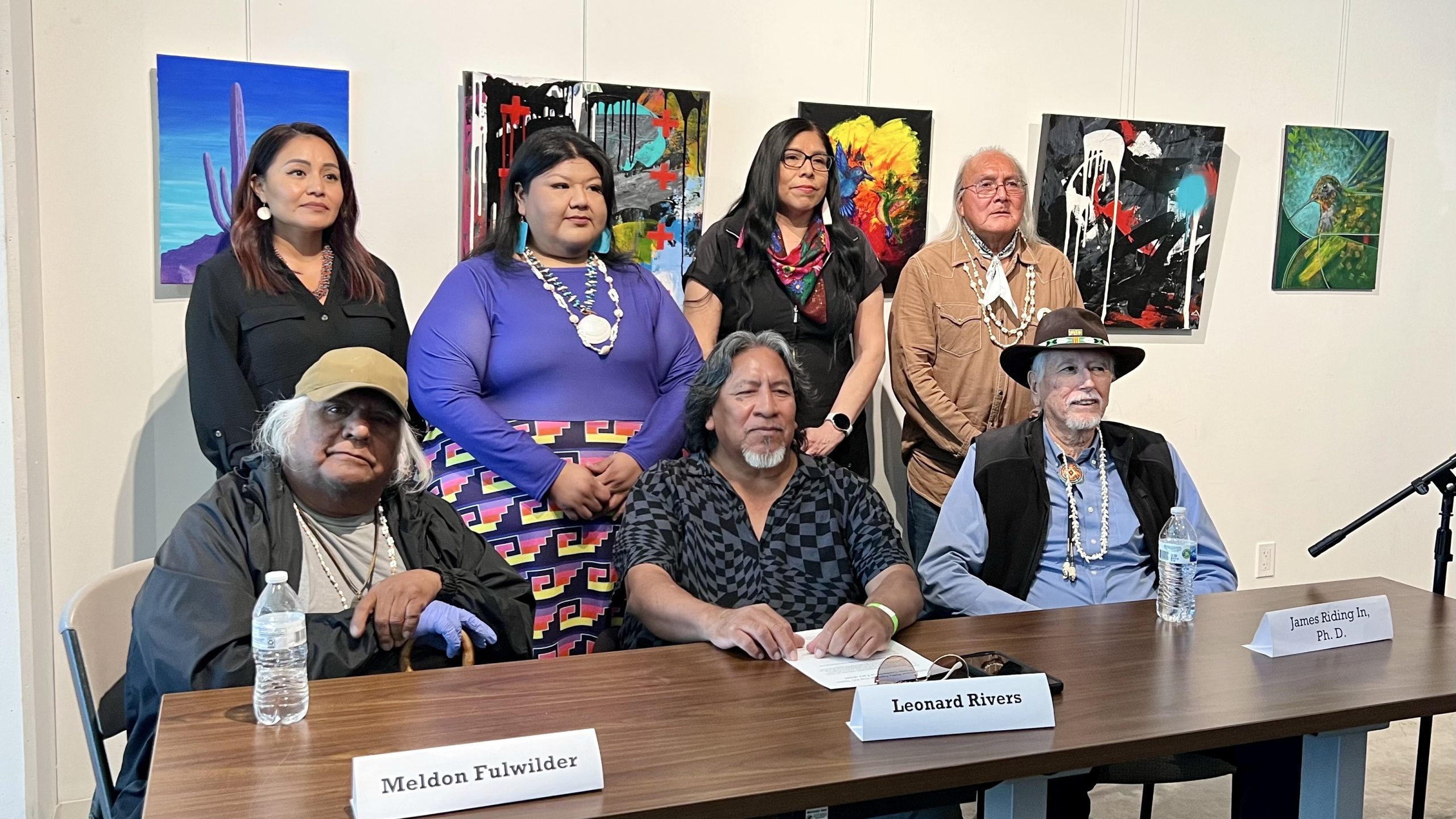
On Thursday, three days before the protest, advocates gathered in downtown Phoenix to demand the immediate retirement of the Kansas City’s name, logo, chop, “big drum,” chant and “all Indigenous appropriation owned and used by the team,” according to a statement.
“As Indigenous people all we want is to live and navigate a world where we can enjoy a TV program on Sunday, or attend a football game without being met with stereotypes like fake headdresses, the tomahawk chop, the mockery of our culture and spiritual ways when the Kansas City fans hit the big drum,” Amanda Blackhorse, a longtime advocate for Native mascot imagery change, said.
Blackhorse was one of seven Native advocates to speak out against Kansas City. She played a key role in the Washington NFL football team changing its mascot.
Related:
— Indigenized Super Bowl
— Super Bowl: Native players work for ‘something bigger’
— Indigenous artist featured at Super Bowl for first time
Meanwhile, like the Kansas City franchise, the NFL continues to ignore Native advocates demanding change. Little has been done over the years, even after the NFL dedicated a season to an “End Racism” campaign that included end zone stenciling clearly visible from the stands and on TV, including at the Kansas City home games.
Kansas City team President Mark Donovan gave no indication that there was room for change. He told The Associated Press Thursday that he respects the right of those opposed to the mascot to demonstrate.
The team has made efforts to address concerns about cultural insensitivities going back a decade but always stop short of altering its name or fan-favorite gestures and chants. Even as teams like baseball’s Cleveland changed to the Guardians in 2021, Kansas City does the least.
It wasn’t until 2020 — when the Washington team first decided to change its name — that Kansas City issued a ban on fans donning tribal headdresses, war paint and clothing at its home stadium. They also changed the tomahawk “chop” with cheerleaders using a closed fist instead of an open palm.
The franchise has also made a point to participate in American Indian Heritage Month, which is in November. Most recently, they posted a video with long snapper James Winchester, Choctaw Nation of Oklahoma, and center Creed Humphrey, Citizen Potawatomi Nation.
Some area Native leaders and tribes have publicly come out in support of the team.
Rhonda LeValdo, Acoma Pueblo, is not one of them. The longtime educator is the founder of Not In Our Honor and is based in Kansas. Any home Kansas City football game, she and others are there to protest. “What we have to endure every single time we stand out there, it’s getting worse,” she said.
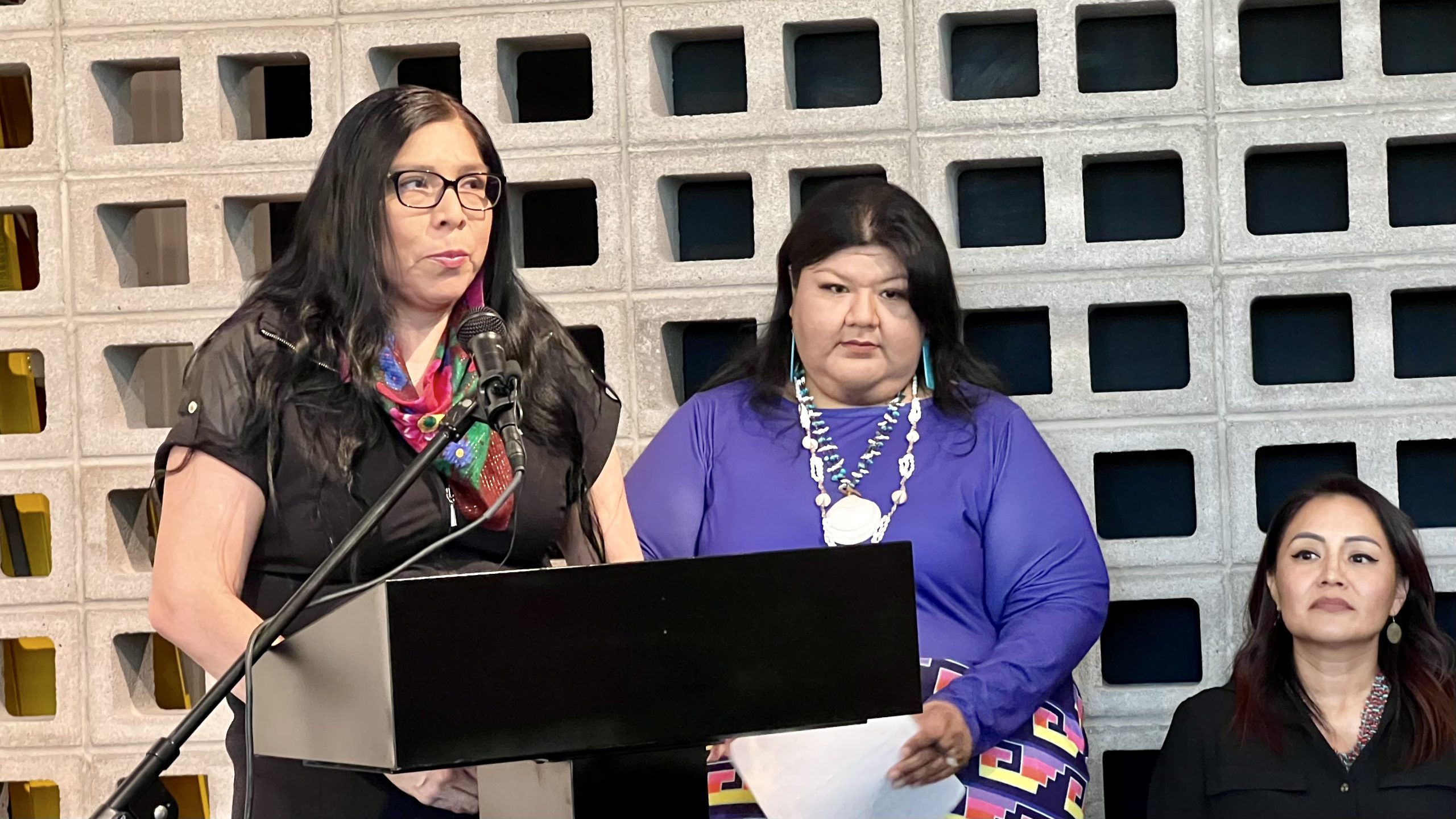
“All we’re asking is for them to change the name and imagery and stop the chop,” Levaldo added. “It’s not like we are asking them to practice our religion, learn our language, take away their kids and make them go to boarding schools because that is what happened to us. I don’t think a lot of people understand the historical trauma that we have to face on a daily basis when they do this to us.”
The others to speak at the news conference also included a few local O’odham advocates who said they came by in solidarity.
Related:
— Native artists shine under Super Bowl opening lights
— Indigenous artist featured at Super Bowl for first time
— Phoenix artist opening doors for future Super Bowls
— NFL shield, an Indigenous take
This week, when asked about the mascot controversy by ICT, Winchester said “I answer that every time the same way, for me, it’s not offensive, but to others, it might be. I’ll leave it at that and I’m just proud to be part of this organization, the Kansas City Chiefs.”
Even for some creatives and partnership, it was a difficult decision to work with the NFL.
Jared Yazzie, Diné, founder of streetwear clothing company OXDX, was part of a NFL merchandise collaboration released over the Super Bowl week. He said he faced a difficult decision late in the process in working with the NFL because Kansas City was involved. Some even questioned him, he said.
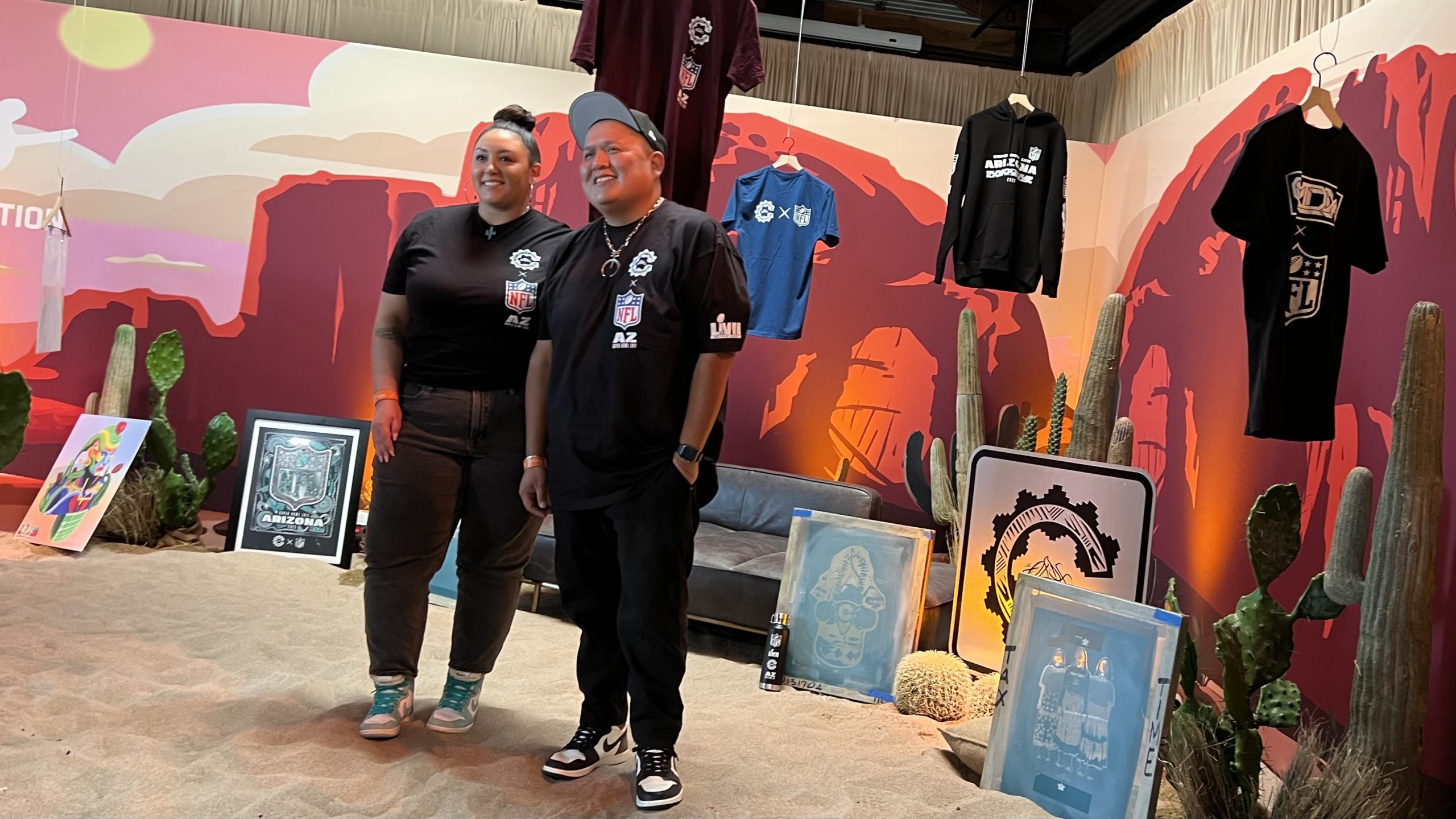
“We as a brand don’t stand by the name, we prefer a different mascot change, we do feel it is degrading towards Native people and it affects the youth of Native America,” Yazzie said. “It was tough to see that they made it, with this project happening, months of planning for it to happen, like that, it was difficult.
“We can only hope that with these kinds of collaborations, their fanbase will be introduced to an Indigenous designer, all these brown voices that are loud and beautiful can showcase some kind of change.”
SUPPORT INDIGENOUS JOURNALISM. CONTRIBUTE TODAY.
The Gila River Indian Community just south of Phoenix has a history of professional sports team sponsorship. The tribe’s gaming enterprises work closely with the NBA’s Phoenix Suns and WNBA’s Phoenix Mercury. The Suns dedicated an alternative jersey to tribes in Arizona and have hosted multiple celebrations of the Indigenous comment this season alone.
Gila River Indian Community Gov. Stephen Roe Lewis said those types of relationships with professional franchises can set the standard for all pro teams. Gila River is a partner with the Super Bowl Host Committee.
As for the mascot issue, Lewis said, “As a tribal leader, I’ve always been very forthright against racist mascot imagery and behaviors as well.”
Lewis stressed that fighting against mascot imagery is a year-long fight.
“All these issues, we just don’t deal with these one time of the year, for Super Bowl, we have to work on these 365 days of the year by making sure we address issues like this, representation, respect, that’s something we have to continue to work on together.”

Ileoso Molina, Yaqui, is a fan of the Kansas City team. He attended the opening night celebration wearing a Kansas City jersey and a beaded medallion in the shape of the team’s arrowhead logo.
Molina said he understands the controversy surrounding the team’s name and gets annoyed by the chop, but chooses to focus on the players and the sport.
“It’s up to the fans to get rid of all that stuff,” he said.
The Associated Press, Dacoda McDowell-Wahpekeche and Noel Lyn Smith contributed to this report.
*Correction: The headline has been changed to accurately reflect the decades of work that has been done against harmful Native mascots.

Our stories are worth telling. Our stories are worth sharing. Our stories are worth your support. Contribute $5 or $10 today to help ICT carry out its critical mission. Sign up for ICT’s free newsletter.

