Greetings, relatives.
A lot of news out there. Thanks for stopping by ICT’s digital platform.
Each day we do our best to gather the latest news for you. Remember to scroll to the bottom to see what’s popping out to us on social media and what we’re reading.
Also, if you like our daily digest, sign up for The Weekly, our newsletter emailed to you on Thursdays. If you like what we do and want us to keep going, support and donate here.
Okay, here’s what you need to know today:
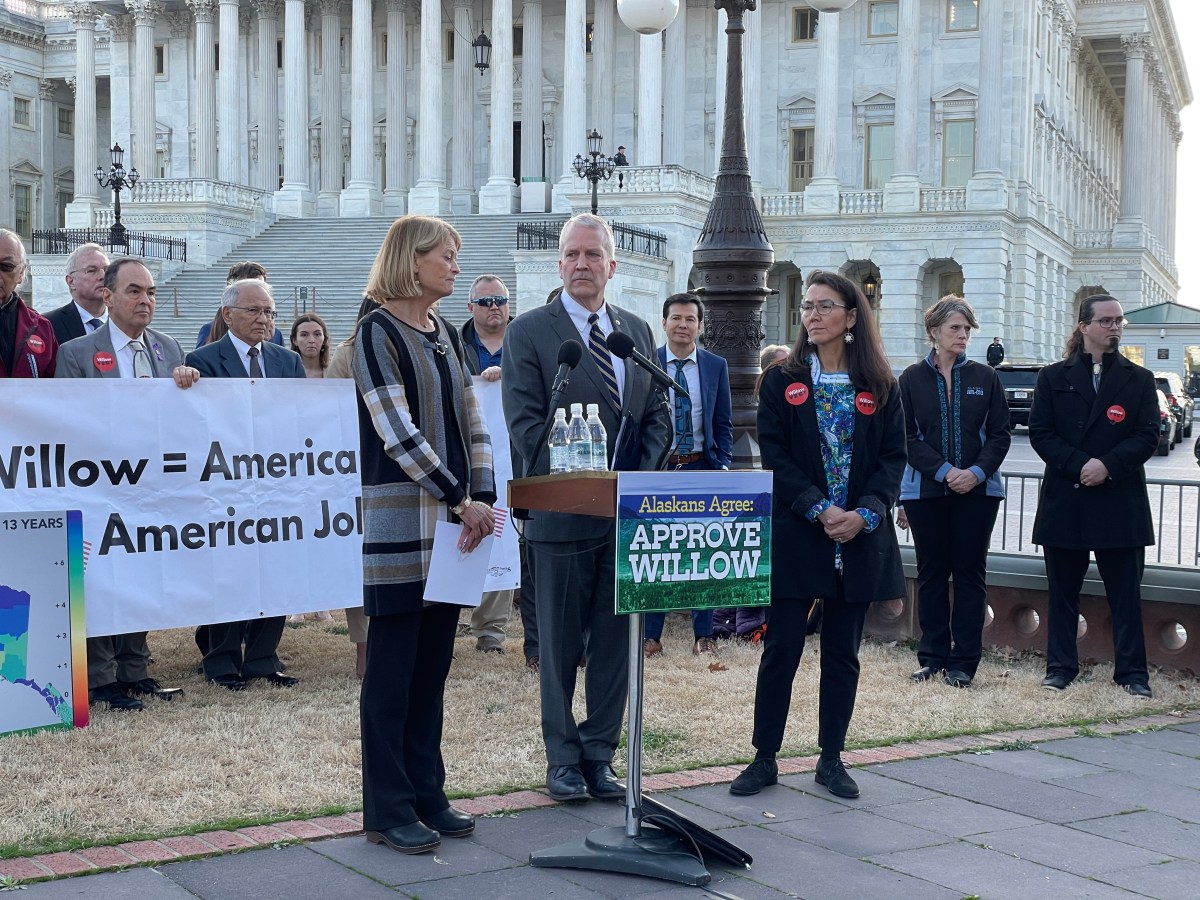
It was overcast in Washington D.C. when organizers from the Sovereign Iñupiat for a Living Arctic stood in front of the White House two weeks ago demanding that President Joe Biden, who ran two years ago on a push for green energy, not approve the Willow Project in Alaska proposed by the Texas-based oil company ConocoPhillips.
The group flew some 5,000 miles to advocate against the project that would further develop some of the most pristine and untouched areas in the entire country.
Then came Monday’s news from the White House when the Biden administration approved the controversial project on Alaska’s petroleum-rich and remote North Slope, a major environmental decision by President Joe Biden that drew quick condemnation by some. READ MORE. — Pauly Denetclaw, ICT
SUPPORT INDIGENOUS JOURNALISM. CONTRIBUTE TODAY.
About 80 people turned out to celebrate Emil Notti’s 90th birthday March 10 at the Alaska Native Heritage Center. Invitees showered the Koyukon Athabascan man with praise for his life of service to the people of Alaska and particularly for his leadership in getting the Alaska Native Claims Settlement Act of 1971 (ANCSA) adopted by Congress.
Notti was the founding president of the Alaska Federation of Natives in 1966, and the unifying force behind the lobbying effort to get the settlement act passed.
Notti’s long-time friend and fellow statewide Native leader Willie Hensley, Inupiaq, said “through thick and thin we worked together, especially those years between 1966 and 1971 when we were just engaged in this humongous battle for our lands.”
At the time, the odds were against them.
“We were fighting everybody. I mean, the state was beating up on us. All the businessmen were against us. The miners, especially the timber people, everybody, in business anyway,” Hensley said. READ MORE. — Joaqlin Estus, ICT
ICT has won a top business journalism award for an investigative report on tax inequities that was produced in partnership with the Center for Public Integrity.
The series, “Unequal Burden,” won its division in the explanatory category in the Best in Business Awards from the Society for Advancing Business Editing and Writing, or SABEW.
Judges said the “breadth of reporting was impressive.”
Among the writers cited for the award were ICT national correspondent Joaqlin Estus and Osage News editor Shannon Shaw Duty, along with James B. Steele of Bloomberg Tax and Public Integrity reporters Maya Srikrishnan, Melissa Hellmann, Ashley Clarke and Joe Yerardi. READ MORE. — ICT
Several U.S. House representatives introduced the Bridging Agency Data Gaps & Ensuring Safety (BADGES) for Native Communities Act, a bipartisan bill that hopes to strengthen tribal law enforcement and increase public safety across Indian Country.
“For years, the federal government has failed to provide tribal communities the resources needed to adequately ensure public safety and properly support Tribal law enforcement agencies,” Rep. Ruben Gallego said in a press release.
This bill is expected to change that by addressing the federal inefficiencies that impact the Bureau of Indian Affairs’ law enforcement recruitment and retention. The proposal aims to increase the effectiveness of federal missing persons resources and give resources to tribes and states to combat the crisis of missing and murdered Indigenous women and girls. READ MORE. — Arizona Mirror
Sign up here to get ICT’s newsletter
On the Tuesday edition of the ICT Newscast, a new project helps tribes keep ancestral stories safe through archives. A new feature film tells the story of Standing Bear, a Ponca leader whose legacy is still seen, and we meet the first female CEO of a top Oklahoma gaming and entertainment company.
Watch:
The youngest school kids in New Mexico are one step closer to seeing commitments to teach cultural education in tribal head start programs.
House Bill 148 mandates the New Mexico Early Childhood and Education Department work with tribes through intergovernmental agreements to administer and provide funding for early childhood programs using a tribe’s cultural teachings on tribal lands.
This bill, sponsored by Rep. Derrick Lente (D-Sandia Pueblo) also gives tribes the ability to determine if the tribal government wants to enter into these programs with the state.
Rep. Wonda Johnson (D-Rehoboth), Diné, supports the bill because it helps preserve Native language and cultures. READ MORE.— Source New Mexico
FOLLOW ICT ON SOCIAL MEDIA: FACEBOOK, TWITTER, INSTAGRAM, TIKTOK.
- National Congress of American Indians looks to year ahead: The organization is celebrating its 80th anniversary this year.
- First Native woman in space is home: ‘That was one heck of a ride,’ said NASA astronaut Nicole Mann after landing into the Gulf of Mexico.
- British Columbia decriminalizes drug possession: The sweeping move is expected to reduce incarceration of the province’s large Indigenous population.
- Filmmaker scores big with Choctaw stickball: Mark D. Williams returns to the big screen with a new documentary about a women’s stickball team.
- Montana Native American tuition waiver could loosen requirements: The Legislature is considering expanding eligibility for the waiver to include descendants of Montana tribes.
- ‘Indian Country really got behind our team.’
- American Indian Academy will close at the end of the school year.
- IllumiNative Founder Talks Native Representation at SXSW: ‘We’ve Never Had Justice.’
We want your tips, but we also want your feedback. What should we be covering that we’re not? What are we getting wrong? Please let us know. dalton@ictnews.org.