Greetings, relatives.
A lot of news out there. Thanks for stopping by ICT’s digital platform.
Each day we do our best to gather the latest news for you.
Okay, here’s what you need to know today:
Brandon Brave Heart stood just outside the powwow arbor late on the night of Aug. 2.
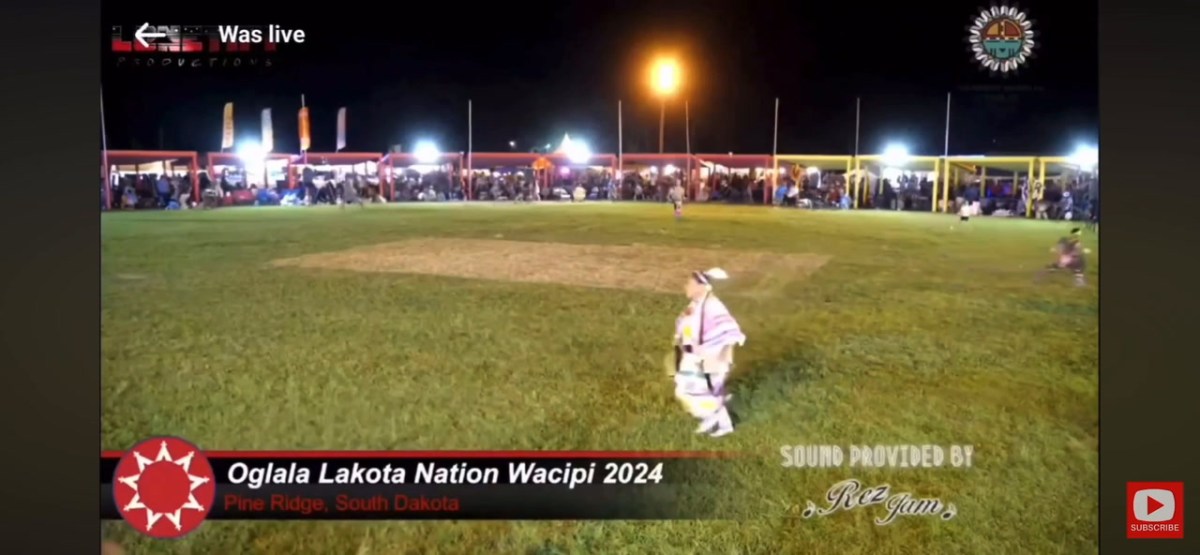
It was after 10 p.m. and the Oglala Lakota Nation Wacipi and Fair was abuzz with people dancing, drumming and visiting with friends and relatives. It was the second night of the annual powwow in Pine Ridge, South Dakota, and Brave Heart was visiting with a friend when he heard several loud pops.
The 40-year-old Lakota man and his friend looked at each other. “Are those real shots?” he asked his friend. Like a scene in a movie, people began fleeing in all directions – mothers grabbed their children’s arms, teenage dancers inside the arbor rushed off the dance ground.
Brave Heart ran toward his drum group to look for his family, but when he got there, his two brothers, nieces, nephews and other family members weren’t there. Men, women, children and elders lay on the ground near the powwow drum. Mothers and grandmothers hovered over the children and grandchildren, many of whom were crying. READ MORE. — Amelia Schafer and Kevin Abourezk, ICT + Rapid City Journal
SUPPORT INDIGENOUS JOURNALISM. CONTRIBUTE TODAY.
It was unlike any viewing of the nearly 50 year screening of “Star Wars: Episode IV – A New Hope.” The first released episode of the iconic series debuted Thursday in Canada, dubbed in Anishinaabemowin, the language of the Ojibwe.
The film was welcomed with the drum and dancers in regalia and a grand entry with the voice actors and representatives from the provincial and federal governments as well as the University of Manitoba, The Dakota Ojibway Tribal Council, regional Chiefs and Lucasfilm.
“I want to start with a traditional introduction from our culture”, said Wab Kinew, premier of Manitoba, who broke out his best impression of a Wookie, growling out like Chewbacca. In keeping with the generational impact of the film, Kinew’s son dressed as a Jawa, spoke out, “Stop it, dad!”
The highly popular provincial premier then broke out into the Anishinaabe language, the language of his ancestors and it was the perfect way to launch the world premiere of “Star Wars – Anangong Miigaading.” READ MORE. — Miles Morrisseau, ICT
So far in August, voters in Tennessee, Michigan and Washington have headed to the polls for their primary elections. Missouri has also held its election, but there are no Indigenous candidates in the state being tracked by ICT.
This month, 40 percent of Indigenous candidates running for public office have their primary election which comes to 71 candidates running across 9 states in August, according to a database managed by ICT and Advance Native Political Leadership. And late last month, the Arizona primaries saw the highest number of Indigenous candidates from any state for the 2024 election cycle.
In Tennessee, there was only one Indigenous candidate running for office. Incumbent Bryan Terry, Choctaw, ran unopposed in the Republican primary election for Tennessee House of Representatives in District 48. He will advance to the general election on Nov. 8. Terry first ran for election in 2014, and has held the seat since he took office in 2015. READ MORE. — Kadin Mills, ICT
In a significant turn of events, an array of Catholic Ursuline Boarding School documents related to the boarding school students of several Indigenous nations in Montana and Alaska will remain in Montana.
Several U-Hauls loaded with every day records, photos, ledgers, scrapbooks and other archives were originally slated to transfer to the Catholic Jesuits in Boston, Massachusetts.
Instead, The History Museum in Great Falls, Montana, successfully secured the keeping of thousands of Ursuline Academy Boarding and Day School records to the Cascade County Historical Society repository. The community building is known as the Ursuline Center now.
Records include vital historical documents of the Northern Cheyenne, Crow, Blackfeet, Gros Ventre, Nakoda, Assiniboine, Salish, Kootenai and Pend d’Oreille people, plus non-Natives who attended the Ursuline schools. READ MORE. — Renata Birkenbuel, ICT
Sign up here to get ICT’s newsletter
When Raye Zaragoza was first approached about joining the Broadway production of ‘Peter Pan,’ her immediate response was to turn down the opportunity.
“Initially, when I first saw (just) ‘Peter Pan,’ I was like, ‘Oh, no,’” Zaragoza said. “‘Peter Pan’ is, like, historically been super racist and harmful towards Indigenous people, so, why would I agree to do this?”
Once Zaragoza, Akimel O’odham descent, had learned that Larissa FastHorse, the first known female Native American playwright with a Broadway production, was in charge of rewriting the original ‘Peter Pan’ story, she was immediately on board.
“When I saw that Larissa was behind it, I was like, ‘Okay, well, if she’s going to be doing the rewrite, it’s going to be good,’” Zaragoza siad. “She’s amazing and I have full respect for her.” READ MORE. — Leah Mesquita, ICT
When Jessica Whitehawk helped start a women’s health support center over a decade ago, her team worked out of a tiny room in the back of a nonprofit office on the Yakama Nation Reservation in Washington state.
Pregnant women traveled to that room from the farthest reaches of the 1.3 million-acre reservation because they had nowhere else to go for health care or prenatal advice, Whitehawk said.
Many tribal communities have a similar lack of resources, which contributes to American Indian and Alaska Native infants being twice as likely as non-Hispanic white babies to die before their first birthday.
A recent study suggests another reason for the high infant mortality rate among Native babies: the way that law enforcement authorities investigate possible cases of sudden unexpected infant deaths, known as SUIDs, in tribal communities. Researchers found that compared with other racial groups, American Indian and Alaska Native SUIDs were most likely to result in police investigations, which were often incomplete, as opposed to the more thorough investigations conducted by medical examiners or coroners’ forensic staff. READ MORE. — Stateline
The South Dakota Board of Education Standards will soon review proposed changes to the Oceti Sakowin Essential Understandings, a set of standards meant to introduce Native American culture, traditions and history into public schools.
The proposed changes are meant to make the standards “more navigable for teachers,” Indian Education Advisory Council Director Fred Osborn told council members at their Thursday meeting.
The updates include new appendices for teachers to access resources, a new map of South Dakota reservations, more Indigenous language usage throughout and more Indigenous language pronunciation guides, among other changes. READ MORE. — South Dakota Searchlight
- Rez dogs are feeling the heat from climate change: A lack of infrastructure and extreme weather are putting unhoused pets on reservations in danger.
- North Dakota gives tribal curriculum guides a digital overhaul: Department of Public Instruction worked in collaboration with the Indian Education Coalition and the University of North Dakota to collect information and digitize the text.
- White Earth Nation inauguration looks to the future: Speaking after the ceremony White Earth Nation Tribal Chair Michael Fairbanks said regaining lands promised under treaty, but later lost through questionable deals, would help everyone.
- Mohawk woman shifting into high gear: Tamara Maracle has a passion for race car driving.
- North Dakotans call on state to deny permits for carbon capture project: Many North Dakotans are concerned about the safety and environmental impact of a carbon capture proposal put forth by Summit Carbon Solutions. Iowa-based Summit Carbon Solutions hopes that the Midwest Carbon Express pipeline will be operational by 2026.
- National Park Service Awards $3 Million to Aid Return of Native American Remains, Sacred Objects.
- Aug. 10 marks the 35th anniversary of unsolved disappearance and homicide of Native American woman.
- Billings basketball tournament honors two Montana ‘basketball legends.’
- Alaska invested millions to fix food stamp backlogs. Some users still can’t get through.
We want your tips, but we also want your feedback. What should we be covering that we’re not? What are we getting wrong? Please let us know. dalton@ictnews.org.