
Greetings, relatives.
A lot of news out there. Thanks for stopping by ICT’s digital platform.
Each day we do our best to gather the latest news for you. Remember to scroll to the bottom to see what’s popping out to us on social media and what we’re reading.
Also, if you like our daily digest, sign up for The Weekly, our newsletter emailed to you on Thursdays. If you like what we do and want us to keep going, support and donate here.
Okay, here’s what you need to know today:
More than 10,000 Native Americans live in Sioux Falls, yet no Native person has ever served on the Sioux Falls City Council, according to the Sioux Falls City Council and Minnehaha County Historical Society.
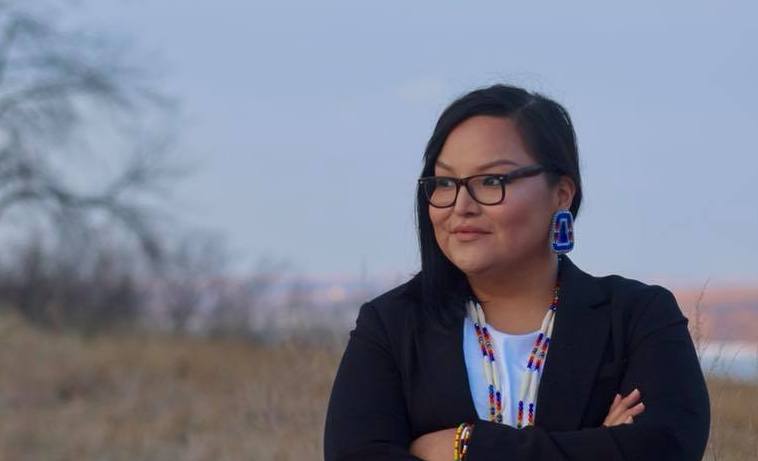
One Hunkpapa Lakota woman, Allison Renville, is hoping to change that.
Renville, who was raised in Sisseton, S.D., on the Lake Traverse Reservation, moved to Sioux Falls over two years ago after surviving domestic abuse. After moving to Sioux Falls she became invested in community protests, domestic violence and sex-trafficking outreach. Since moving to Sioux Falls, Renville said, she’s put over 1,000 miles on her car traveling around the Sioux Falls metro area helping with community projects.
“We have the ability to create our own narratives and do what we can for Sioux Falls,” Renville said. “I bring in such a deeper understanding of the city as someone who holds conversations with houseless people, sex-trafficking survivors and domestic violence survivors.
Rapid City, the second largest city in the state, has had several Indigenous city council members and school board members over the years. Sioux Falls, the largest city, has never had a Native American council member. READ MORE — Amelia Schafer, ICT and Rapid City Journal
SUPPORT INDIGENOUS JOURNALISM. CONTRIBUTE TODAY.
Sign up here to get ICT’s newsletter
Born and raised mostly in Portland, Oregon, Shyla Spicer, an enrolled citizen of the Yakama Nation and a descendant of the Seneca Cayuga Tribe who also has Filipino heritage, grew up deeply involved in the urban Native community. In December, she started her new role as president and CEO of the Native Arts and Culture Foundation.
Spicer’s traditional Yakama name is Wachea’wit, which means water rapids. She aspires to create a hub for the Indigenous community as a whole, and continue the foundation’s work supporting Indigenous artists across Portland, the country and beyond.
Formed in 2007, the Native Arts and Culture Foundation has spent the last 17 years supporting Indigenous artists through grants, opportunities to showcase their work, artist fellowships and more.
“I think that this is a place that artists and guests can come and just be inspired, because art does touch us in ways that we can’t even articulate sometimes,” Spicer said. “To be able to share culture and story and past and present and all of that is just so powerful. And doing it from an Indigenous voice and consciousness not the other way around.” READ MORE — Nika Bartoo-Smith, ICT and Underscore News
ORLANDO, Fla. — Opponents of online sports betting in Florida on Thursday lost their latest fight against a Seminole Tribe agreement with the state that permits the gambling.
The Florida Supreme Court ruled that the opponents had filed the wrong type of petition to challenge the compact between the Seminole Tribe of Florida and Gov. Ron DeSantis’ administration. The deal will rake in hundreds of millions of dollars from online sports betting and other forms of gambling for both the tribe and state government.
The decision was the latest setback for West Flagler Associates and Bonita-Fort Myers Corporation, which operate racetracks and poker rooms in Florida. They also are challenging the compact in federal court and have petitioned the U.S. Supreme Court to take up their case.
An attorney for the opponents didn’t respond to an email seeking comment. The court’s ruling permits the opponents to file a motion for a rehearing on the case.
The two parimutuel firms say the compact signed by the governor and the tribe in 2021 gives the tribe a sports betting monopoly. They also argue that it creates a backdoor way out of a requirement, passed by voters in 2018 as an amendment to the Florida Constitution, that a citizens initiative is needed to expand casino gambling outside tribal land. READ MORE — Associated Press
A marathon trial on the Dakota Access Pipeline protests featuring testimony from over 30 witnesses wrapped up Thursday.
Over the span of 18 days, law enforcement, government officials, protesters and outside experts took the court through virtually every part of the demonstrations that drew national attention.
Here’s a recap of the case and four key takeaways from the trial.
Background
North Dakota is asking a judge to order the U.S. to pay $38 million for costs it says it suffered policing protests against the Dakota Access Pipeline, also known as DAPL, in 2016 and 2017.
Protesters came to south-central North Dakota in solidarity with the Standing Rock Sioux Tribe, which opposed construction of the pipeline out of concerns the project intruded on tribal land and could contaminate the tribe’s water supply. READ MORE — North Dakota Monitor
- Rebuilding after 2009 Yukon flood: ‘This is a really great, great award for the village’
- Tribes call for apology from SD governor: Inflammatory comments made by Governor Kristi Noem at two separate town hall meetings on March 13 prompted three tribes to call for an apology from the governor
- New NAGPRA rules: ‘We have an obligation to change’: Part 3: Native curators offer a model for future Indigenous exhibits
- GLOBAL INDIGENOUS: Australian Indigenous royalties at issue: Coverage around the world on Indigenous issues for the week ending March 17, 2024
- ‘I Got Your Black’ is exposing travelers to all things Afro-Indigenous in Mexico
- Cocopah Tribewill restore areas along the Colorado River to address climate change

We want your tips, but we also want your feedback. What should we be covering that we’re not? What are we getting wrong? Please let us know. dalton@ictnews.org.

