
Help ICT make strides in 2024. Our goal is to raise $150,000 by the end of the year with generous contributions from funding partners and collaborators like you. We’re thankful for your support, and we’re thriving because of it. DONATE TODAY!
Amelia Schafer
ICT + Rapid City Journal
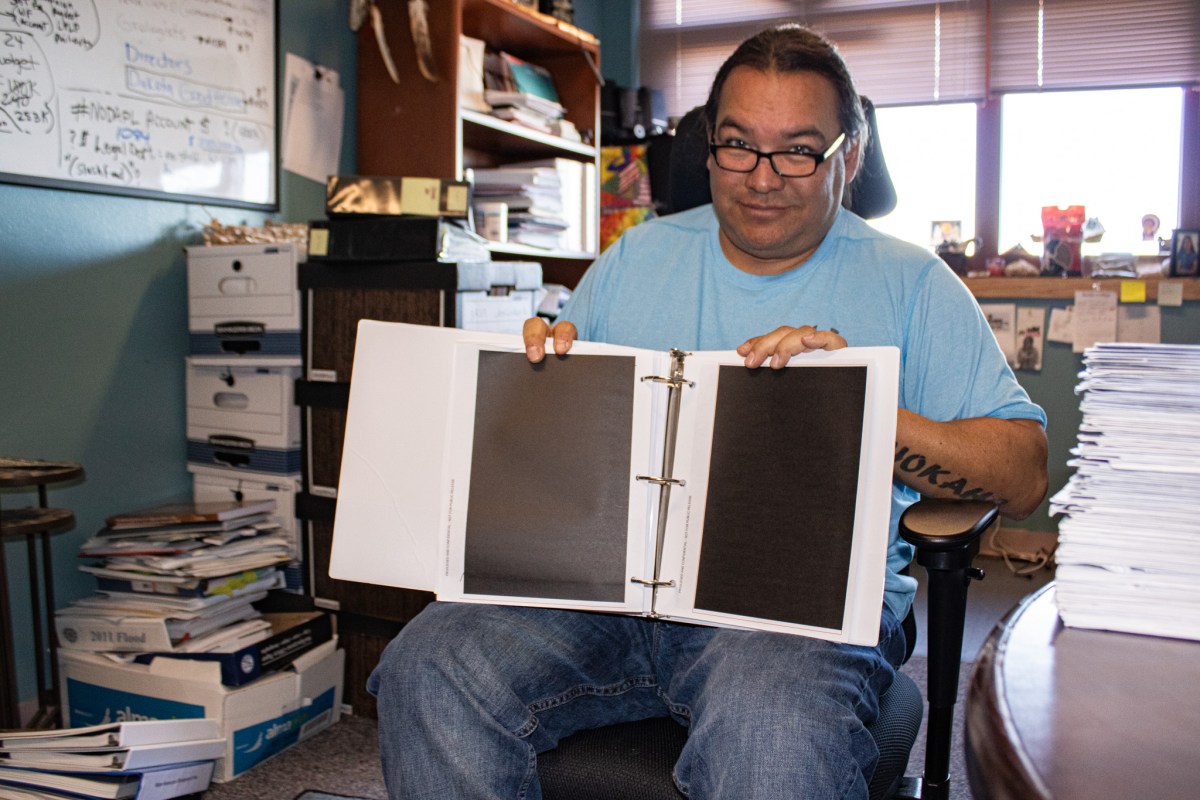
FORT YATES, N.D. – Doug Crow Ghost, Hunkpapa Lakota, opens a large binder labeled “Volume II: Dakota Access Pipeline Lake Oahe Crossing Project Draft Environmental Impact Statement.” The binder is supposed to contain instructions for the tribe should there be a leak in the Dakota Access Pipeline. Instead, the entire page is redacted, replaced with a massive black square.
“So, this is what we do if there’s a leak,” said Crow Ghost, water administrator for the Standing Rock Sioux Tribe, holding the binder open to two entirely redacted pages.
A public forum held November 1 and November 2 in Bismarck was meant to be an opportunity for concerned citizens and tribal officials to provide feedback on the draft Environmental Impact Statement (EIS). The EIS outlines five options for the future of the pipeline. Options include denying the easement that allows for the Cannon Ball, N.D.; crossing, abandoning or removing the segment; granting the easement with no changes or additional safety measures; or rerouting the pipeline north of Bismarck.

The Bismarck format of the public forum upset many in attendance. Many, including Standing Rock officials, expected a public hearing-style forum. Instead, the forum was a one-on-one meeting with a stenographer present to write down concerns. There was also an opportunity for individuals to write comments.
Standing Rock tribal leaders said several tribal leaders, citizens and general community members were unable to enter the building where the forum was held. Tribal officials said Bismarck law enforcement asked for identification from anyone attempting to enter. A sign posted outside on November 2 said meeting by invitation only, no media allowed.
Standing Rock Chairwoman Janet Alkire called for the draft review to be invalidated and the pipeline shutdown. Alkire voiced concerns over online comments made not being fully considered.
A press release from the tribe called the forum undemocratic.
“The quietly announced sessions initially excluded key tribal participants. Would-be speakers were also asked to submit written comments or were siloed with a stenographer rather than being heard in a truly public forum,” the press release said.
Following the forum, the period for online public comments was extended to December 13. Standing Rock officials said over 60,000 comments have been submitted so far.
Neither the U.S. Army Corps of Engineers nor Energy Transfer Partners, which owns the pipeline, responded to requests for comment.
Since finding out the pipeline would cross over the Standing Rock Sioux Tribe’s treaty territory, the tribe has fought to stop the crossing. After years of legal battles, protests and pushback, the pipeline continues to move more than 1 million barrels per year of crude oil from the Bakken Oil Fields of North Dakota to Paktola, Ill. The pipeline has remained in service since June 2017.

The EIS draft was created by a January 2021 ruling by the U.S. Court of Appeals for the District of Columbia that said the Army Corps’ existing National Environmental Policy Act analysis did not address potential impacts on Standing Rock and other tribes. The court left it up to the Army Corps to decide whether to keep the pipeline in operation during this period. In May of that year, the Biden administration announced the pipeline would remain in operation.
The new EIS came out on September 8. Crow Ghost said 80 percent of the stack of three binders he received that make up the EIS is redacted, offering him little instruction on a potential spill.
Another main issue in the ongoing fight is whether or not the pipeline infringes on the tribe’s land.
The pipeline crosses directly through land taken by Congress in 1958 around the time the Oahe dam was built, less than a mile from the reservation’s current northern boundary. This land and all land up to the Heart River were guaranteed to the tribe by Article II of the 1851 Treaty of Fort Laramie.
Additionally, by crossing over the Missouri River, the pipeline has the potential to impact the tribe’s main water source.
The Army Corps of Engineers said the tribe’s water intake source was moved 75 miles south once the pipeline was installed. What was not moved were the more than 1,000 cultural sites along the Missouri River bed.

Several tribal members, including Tim Mentz, the Standing Rock Sioux Tribe communications director and former tribal historic preservation officer, attempted to ask about this during the November forums in Bismarck. Mentz was unable to speak to anyone from the Army Corps.
Instead of a forum, concerned citizens would speak one-by-one for up to three minutes to Army Corps representatives, then leave. Mentz said he and six tribal officials from Standing Rock and Cheyenne River were left waiting outside.
“We were lined up outside. Law enforcement was asking for IDs from people before they could enter. It began to turn into a protest,” Mentz said. “It reminded me of 2017.”
In 2017, protests erupted in North Dakota around the Lake Oahe crossing point. Tribal citizens, allies and even celebrities came to protest the pipeline’s construction. More than 30 individuals were arrested and the state of North Dakota issued an order to break up the protests in February 2017.
Mentz said he still has not heard of any plans for what would happen to human remains after a spill.
In the early days of the DAPL protests, Mentz was still working as a tribal historic preservation officer. A survey conducted of the area in 2016 indicated there were 87 sacred sites in a two-mile radius of the pipeline’s crossing point over Lake Oahe, part of the Missouri River.
The Missouri River itself has great cultural significance to the tribe, Mentz said. This is why there are so many cultural sites along the riverbanks. Mentz said the tribe believes the Little Missouri River, a tributary of the Missouri River, is the oldest river system in the world.
The Missouri River itself runs either along or through 11 reservations, six of which are in South Dakota. Besides reservation communities, as many as 10 million people live along the Missouri River as it runs through Montana to St. Louis where it meets the Mississippi River.
Mentz said there are more than 1,000 cultural sites just in the area along the Lake Oahe Reservoir. Many of the burials are between 100 and 1,000 years old. A majority belong to the Mandan, Hidatsa and Arikara Nation and 64 belong to Standing Rock.
In 1960, during the creation of the Oahe Dam and Lake Oahe Reservoir, 24 burial sites were submerged in the Missouri River. These 24 sites are at high risk of contamination if the pipeline were to break.
“How do you mitigate oil-soaked human remains?” Mentz said. “In soil mitigation, it’s disposed of. Does that mean our relatives will be disposed of?”
Cultural sites have already been disrupted by the pipeline, Mentz said. On September 3, 2016, during the creation of the pipeline, Energy Transfer Partners demolished a two-mile area near Cannon Ball containing sacred sites and artifacts. Several archaeological sites were preemptively bulldozed. The tribe issued a formal statement asking for construction to cease, but the request was denied.
“From Alaska to the tip of South America, all we’ve known for the past 500 years is survival, and we’re still doing it,” Crow Ghost said.
In the days leading up to the December 13 EIS public comment deadline, the tribe is working to make their voices heard.
With the help of numerous technical experts such as oil spill model experts, climatologists, geologists and more, the tribe is compiling a comprehensive document to present to the Army Corps beforehand.
The tribe is also requesting a congressional hearing regarding the destruction of cultural sites and human remains in the pipeline’s creation.
“It’s important that we stay ahead of this all because the (pipeline) companies are,” Crow Ghost said. “The environment, the destruction of cultural sites and Indigenous communities are all secondary to them. Their primary goal is to make money at any cost. It’s not about conservation or protection. It’s all about money.”

This story is co-published by the Rapid City Journal and ICT, a news partnership that covers Indigenous communities in the South Dakota area.
Our stories are worth telling. Our stories are worth sharing. Our stories are worth your support. Contribute $5 or $10 today to help ICT carry out its critical mission. Sign up for ICT’s free newsletter.

