
Richard Arlin Walker
Special to ICT
TULALIP INDIAN RESERVATION —The Tulalip Tribes will retain all sales tax revenue generated at its Quil Ceda Village beginning July 1, 2027, after two decades of grappling with the State of Washington over its taxation of non-Native business transactions on Tulalip lands.
A state law approved in 2020 and modified in 2025 settled a long-running dispute that had cost Tulalip Tribes at least $450 million in tax revenues collected in the commercial and retail community that Tulalip built on its lands decades ago and consolidated as a municipality.
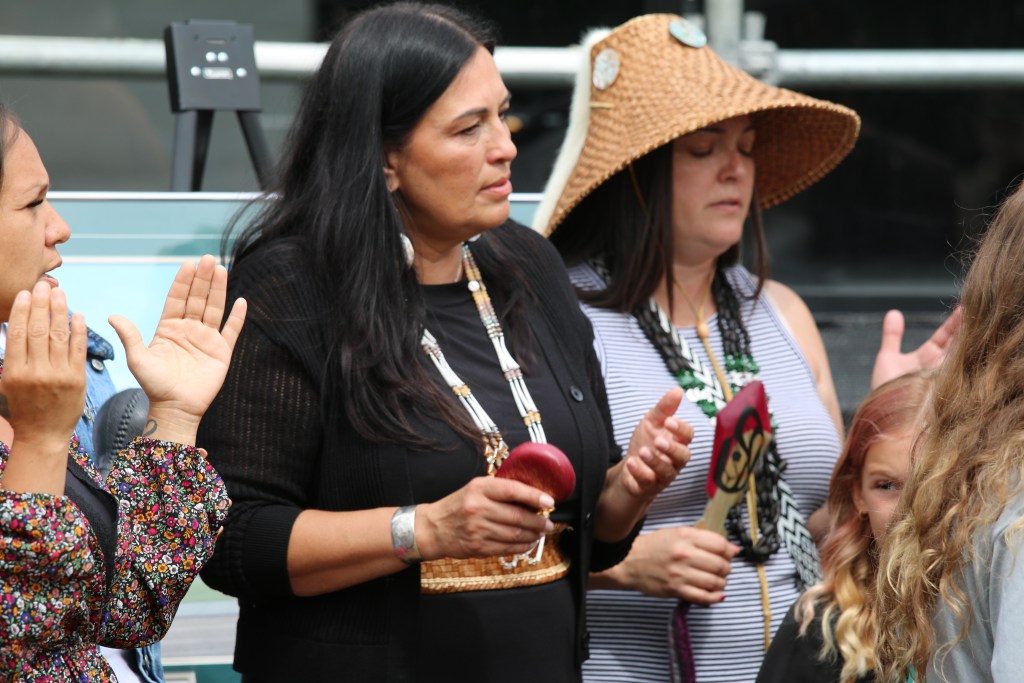
“Quil Ceda Village is more than a collection of businesses; it is an exercise of tribal sovereignty,” Tulalip Tribes Vice Chairwoman Deborah Parker said Aug. 8 at the village’s 25th anniversary celebration. “It is a statement that the Tulalip Tribes can govern, build, invest, and create opportunity on its own terms.”
The State of Washington had long asserted it had the authority to tax business transactions conducted by non-Native-owned businesses at Quil Ceda Village. Tulalip Tribes, which chartered the village as a municipality, sought a share of that sales tax revenue to help fund public services it provides to the village’s 11,000 daily visitors, 150 businesses and 5,600 people who work there.
The state returns a share of sales tax revenue to local governments to help fund public services, but the state didn’t recognize Quil Ceda Village as a municipality and instead gave the tax revenue it collected there to Snohomish County, which shares geography with the Tulalip Reservation.
Tulalip Tribes council member Teri Gobin said the state collected $450 million in taxes at Quil Ceda Village from 2001-2015. Without a share of that revenue, the Tulalip Tribes and Quil Ceda Village were backed into a corner: They could impose their own sales tax, which in addition to the state‘s tax could drive businesses away, or redirect tribal government funds from other programs to the village.
Tulalip Tribes sued the state in federal court in 2015 and lost, but as it prepared an appeal the state offered a settlement: legislation establishing tribal tax compacts that would return a sliding scale of sales tax revenue to tribal nations in exchange for capital project funding. The state pledged to return 50 to 60 percent of tax revenue to Quil Ceda Village in exchange for a contribution of $35 million for a behavioral health facility the state said was needed in the region.
In the ensuing years, Tulalip Tribes never received more than 43 percent, Gobin said. Meanwhile, Tulalip built Fern Lodge Behavioral Wellness, a 32-bed inpatient treatment center, in Stanwood. It opened in 2025 and is operated in partnership with the Washington State Health Care Authority.
“We had a conversation with the state Department of Revenue. We said this isn’t right – you promised us this, we did our end of the deal and you haven’t,” Gobin said. “And they agreed.”
The department asked the Legislature to modify the revenue-sharing compact to increase Tulalip Tribes’ share of sales tax revenue to 100 percent, and the measure was approved last year.
Gobin said the change isn’t a loss to the state because the tax revenue stays local and is put back into the region’s economy.
‘Dirt and dreams’
Quil Ceda Village sits on four square miles of the 35-square-mile Tulalip Reservation. It’s located on Interstate 5, some 39 miles north of Seattle and 76 miles south of the U.S.-Canada border, and is governed by a village council.
Until site planning began in 1999, the land on which the village sits was what elders called a place of “dirt and dreams” — an undeveloped swath of land along the reservation’s eastern boundary fronting I-5.
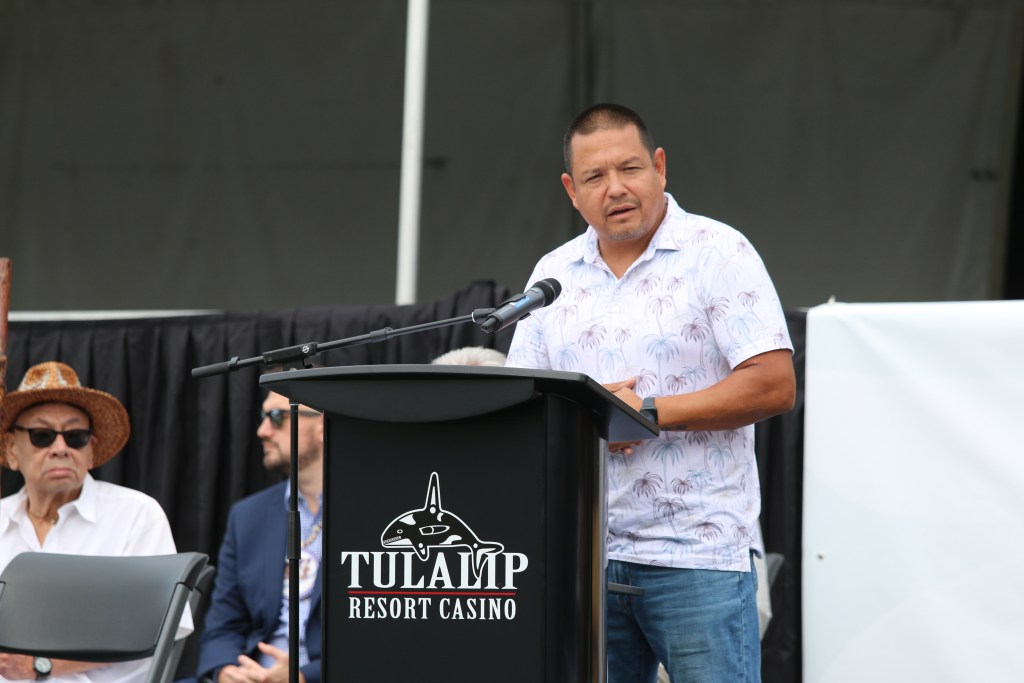
Les Parks was a freshman council member in 1996 when an overpass was dedicated at 88th Street, making it easier for motorists to get off I-5 onto the Tulalip Reservation or the neighboring city of Marysville. At the time, it was a bridge to nowhere, Parks said, “because on this side of the freeway was just a stand of trees.”
As early as the 1930s tribal leaders had envisioned economic development taking place there, he said, and the time seemed right to fulfill that vision. The population of Snohomish County had grown in population from 337,720 to 606,024 in 20 years, according to the U.S. Census. The tribes’ Quil Ceda Creek Casino, located a couple of blocks off the highway, was in need of expansion after only seven years of operation. Walmart was interested in building a store nearby.
No banks would lend the Tulalip Tribes money then, however, so the Tribes obtained a $5 million economic development loan from the Bureau of Indian Affairs.
“We were looking forward as our ancestors before us wanted us to,” Parks said. “It wasn’t us that planned this. It was the leaders of the 1930s, ’40s and ’50s who set aside this 2,000 acres with a vision of what we see today. We just happened to be the ones that got to implement it.”
Parks accompanied Chairman Herman Williams, Vice Chairman Stan Jones, and economic development manager Peter Mills to Bentonville, Arkansas, in 1999 to talk with Walmart’s brass about the location of its proposed store. Tribal leaders wanted Walmart to build in the new Quil Ceda Village; Walmart insisted on another site on the reservation.
Tribal leaders stood their ground. “We basically gave them an ultimatum: either move to Quil Ceda Village or we’re out of here,” Parks recalled. “And they relented.”

Walmart opened in 2001, followed by Home Depot, Tulalip Resort Casino, and Seattle Premium Outlets.
Today, Quil Ceda Village is one of the largest employers in the region. Tulalip Resort Casino and Quil Ceda Creek Casino have each undergone a couple of expansions. The Tulalip Resort Casino Hotel is one of the tallest buildings in Snohomish County and its T Spa is one of the largest spas in the state. Seattle Premium Outlets is the largest outdoor outlet shopping center in Washington.
Visitors can stroll tree-lined trails or landscaped walkways to the Tulalip Resort Casino, Cabela’s Sporting Goods, or the Hibulb Cultural Center and Natural History Preserve to view monumental artworks by prominent Tulalip Tribes artists such as Joe Gobin and James Pasaiukes Madison. Another stroll leads to the Tulalip Amphitheater, which features top-name performing artists in an intimate 3,000-seat setting.
Village government services include building plan reviews, permitting and inspections; business and food service inspections; parks and trails maintenance; water, stormwater and wastewater management; traffic planning; utilities; and wetlands protection. Law enforcement is provided by Tulalip Tribes Police, and fire protection and emergency medical services are provided under a fee-for-service contract with the Marysville Fire District.
The Tulalip Tribes contribute funding to the sheriff’s office and state patrol, helped pay for two highway interchanges, and since 1993 have donated more than $120 million to local organizations, the village office reports.
Past leaders encourage expansion
Parker said Quil Ceda Village is “a model for innovation” in Indian Country.
“I’m proud of the creation of Quil Ceda Village,” she said. “It was created through vision, determination, and a willingness to fight for the tribes’ right to exercise sovereignty and economic self-determination.”
Mel Sheldon, a former Tulalip Tribes chairman and council member, said Quil Ceda Village has made the Tulalip Tribes a recognized economic force.
“It’s unbelievable the challenges that we’ve faced and overcome,” Sheldon said. “In the 1990s, we couldn’t even borrow five bucks, but today I bet you if you went to Bank of America they would loan us $300 million or $400 million. We’ve marshaled our debt well and they believe in us. They believe that we are an economic force.”
Past and present leaders said they hope Quil Ceda Village continues to grow. Sheldon encouraged village leadership to annex 1,600 adjacent acres on the reservation.
Parks said current leaders should follow the example of their predecessors.
“I’m hoping today that this current board looks back and sees what that former board did and don’t be so risk averse,” he said. “Be willing to step out on that limb and take some risk. Mitigate that risk, but take some risk and do what this other board did and develop more on this reservation.”
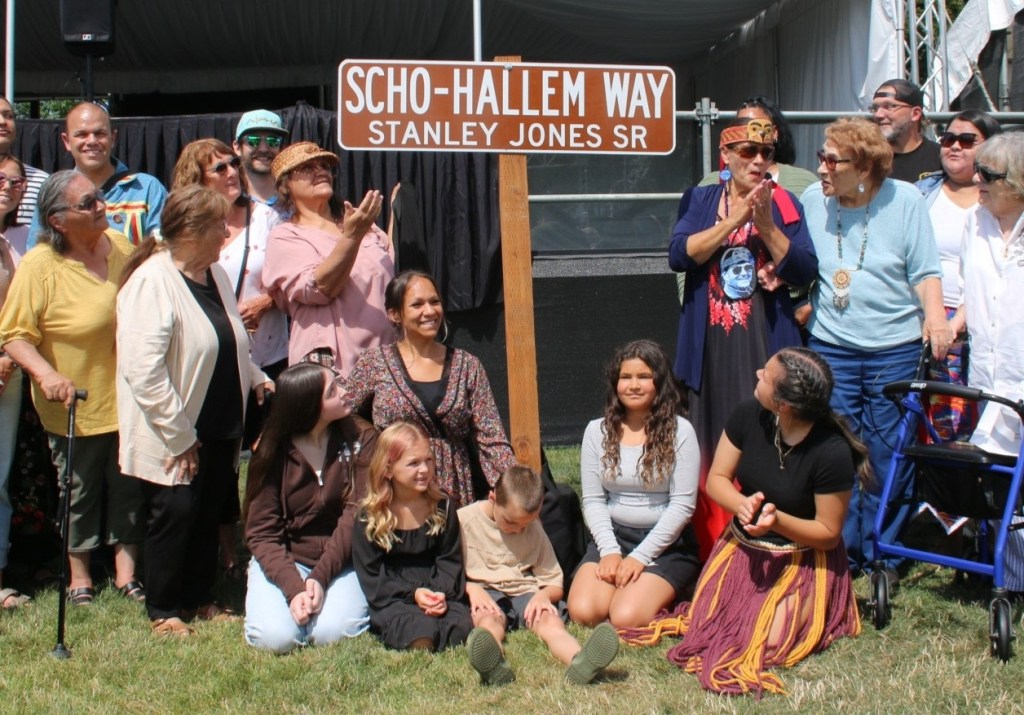
Gobin’s father, Stan Jones (1926-2019), served 44 years on the council, including 26 years as chairman, and helped guide the Tulalip Tribes to economic prosperity. A Quil Ceda Village street was named in his honor Aug. 8.
Gobin spoke of the contributions of other past leaders too, among them John McCoy (1943-2023), who managed Quil Ceda Village before serving 17 years in the state Legislature; Michael Taylor, a Tulalip Tribes’ attorney who helped create Quil Ceda Village as a federally chartered city; and Mills.
“John McCoy and Peter Mills were both my supervisors at one time and it was awesome to work with them,” Gobin said. “The legal staff has done an amazing job. The dedication of the board members who do the negotiations and lobbying and make those relationships happen got us to this point. I want to acknowledge the past board members and their visionary leadership, because without their first steps, we wouldn’t be where we are today.”