
Amelia Schafer
ICT
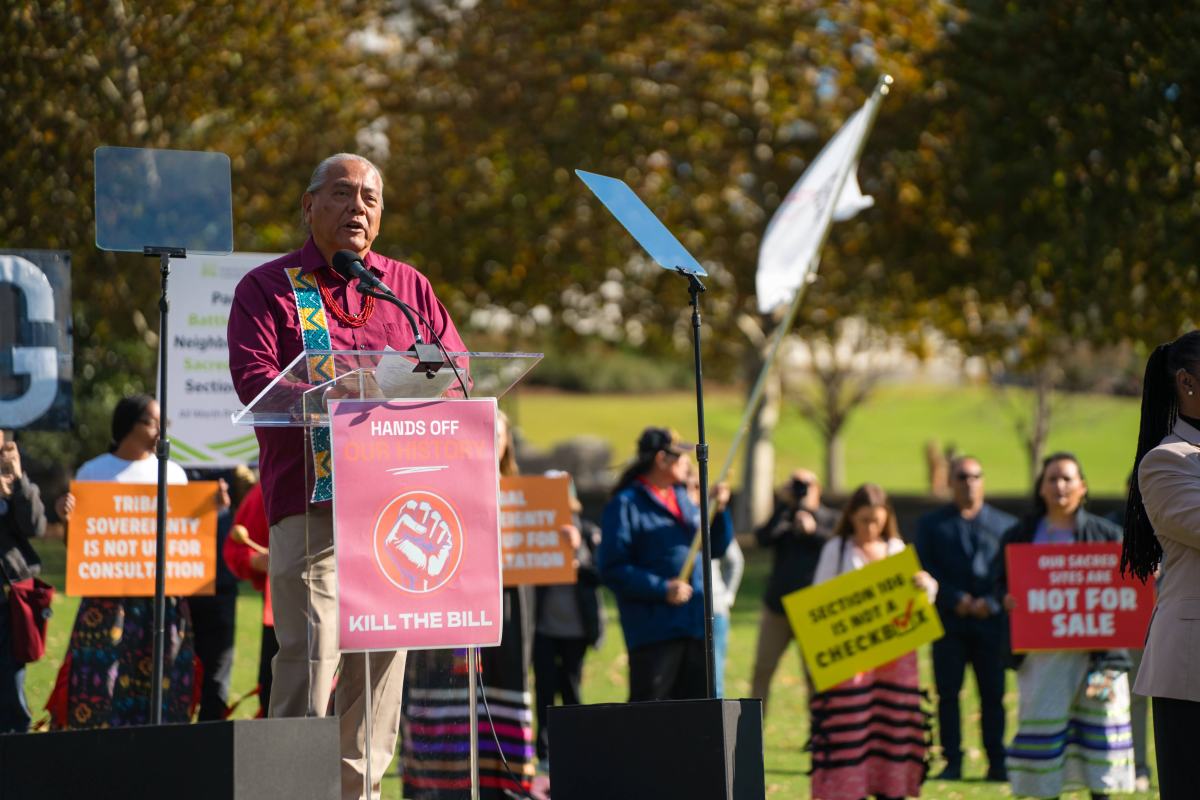
If Congress passes a bipartisan bill aimed at streamlining the development of energy infrastructure projects there would be nothing stopping a uranium mine proposed by the Trump Administration from opening on Mount Taylor, a sacred site for dozens of tribal nations in New Mexico.
“That would be like uranium mining in Jerusalem,” said Rep. Melanie Stansbury, D-N.M, on Monday during a press conference called to denounce the bill. “Why would we take the risk of allowing a few extra transmission projects to go through for the permanent destruction of a sacred site that has been protected for thousands of years? It is not worth it. The risk is not worth it.”
The bill, known as the Bipartisan Affordability and Jobs Act, or BAAJA, passed the Senate last week and could be taken up by the House of Representatives when it reconvenes after the Thanksgiving break. The bill aims to fast track the permitting process for projects like data centers, power plants, transmission lines and more. One ramification of the legislation would be the gutting of current protections guaranteed to tribal nations through the National Historic Preservation Act.
With days to spare, tribal leaders are asking members of congress to vote no on the bill.
“We’re not opposed to infrastructure, we’re not opposed to the advancement of technology,” Joey Sanchez, Santa Ana Pueblo and Chairman of the All Pueblo Council of Governors, said during Monday’s press conference. “All we’re saying is we want a seat at the table to have our voices heard for us to protect areas that are important, to protect areas that are significant to our culture, to our history.”
Title III of the BAAJA bill includes changes to Section 106 of the National Historic Preservation Act that would remove the obligation to consult with tribes regarding projects on or near sacred or culturally important sites. The section would also strip power from Tribal Historic Preservation Officers. If an officer is deemed to be moving too slowly, the Department of the Interior would be able to assume the officer’s duties and oversee the project themselves.
“[But] how are they [the department] able to justify what is sacred and not sacred,” Sanchez asked. “Only the indigenous communities that are within that area have that ability.”
Under the bill, a database of the locations of sacred sites would be created to aid in the identification process, Sanchez said, which is another concerning aspect to leaders.
“There’s a lot of just different avenues that they are doing within this bill to gut our voice,” Sanchez said. “And that’s our biggest concern. … We’re not just opposing just because we don’t like it. We’re opposing this because it affects all of us, not just indigenous communities, but our neighboring communities too.”
BAAJA has been opposed by tribal advocates including the National Congress of American Indians, the All Pueblo Council of Governors, the Great Plains Tribal Chairman’s Association, United South and Eastern Tribes, Rocky Mountain Tribal leaders council and others.
“This fight is not political, it’s not about any one person,” Stansbury said. “This fight is about protecting the sacred.”
Should the bill pass into law, it would be extremely difficult to undo many of these changes, said Tracy Stone-Manning, president of non-profit advocacy group the Wilderness Society and former director of the U.S. Bureau of Land Management.
“Under this bill, once permits are issued, future administrations wouldn’t be able to change them or rescind them,” Stone-Manning said. “Even if new science comes to light, even if the permit is unlawful, and on top of that, it silences public input and erodes tribal sovereignty.”
Aside from direct threats to tribal sovereignty and the government-to-government relationship tribes hold with the federal government, leaders expressed concern at the bill’s proposed changes to the Endangered Species Act and Clean Water Act.
“Animals … can’t speak for themselves,” Sanchez said. “So we, as Indigenous community, speak for them. We speak for the areas that we want to protect. We speak for items or places that can’t speak for themselves. That’s why we’re in this fight. That’s why we’re opposing it, because you’re taking away from who we are and what we represent, and how we’re trying to make this a better place for the future of our people, for the future of everyone.”
Sanchez said no legislators consulted with tribal nations regarding the bill prior to its proposal and passage. Tribal leaders found out about the bill two weeks before it was introduced, Sanchez said.
“It gets me worked up when I think about this,” Sanchez said. “How can someone come in and say we don’t mean anything? That us, as Native Americans, as Indigenous people, are secondhand? We are the first occupants of this continent, [these] places that have been sacred to us for thousands of years. That is something that can never be replaced. We are strictly and adamantly opposed to this bill.”
At this point, it would be more efficient to kill the bill as it stands and rework it in the future than to work on amending it, Stansbury said, noting that the bill has taken an unorthodox route to debate. Rather than moving through traditional channels in Congress where problems are first identified and public hearings can be held, Stansbury said the bill was hatched behind closed doors and released on Sept. 30 with no public hearings.
“Everyone was on the campaign trail while it was released, and it did not ever have any public process except for the Senate trying to ram it through the floor the first day we got back in session after the election,” Stansbury said. “What we are calling for is a public process for it to come back in front of Congress in January, in February, and for us to have these conversations in the public forum, in the public square.”